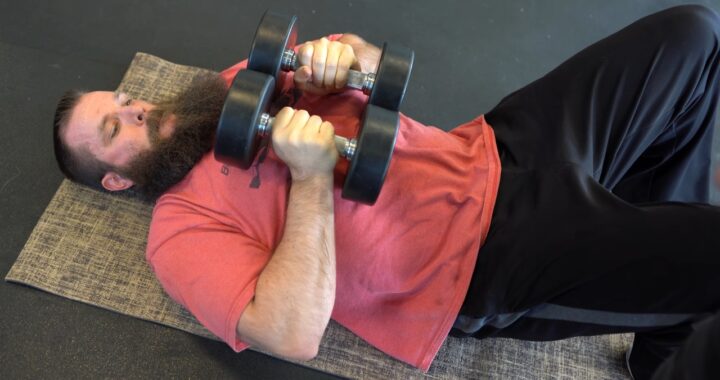
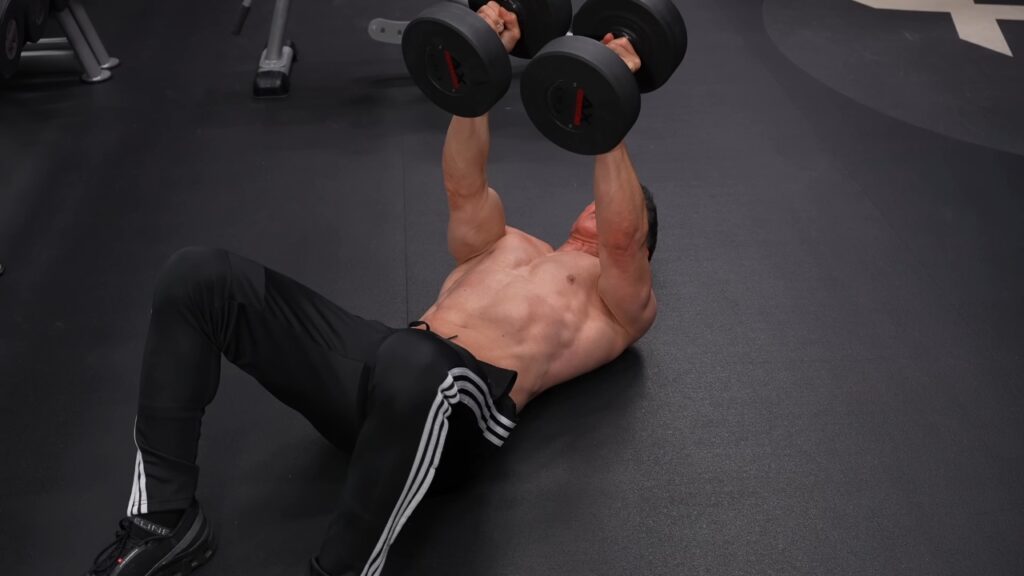
The dumbbell floor press is one of our favorite starting points for anyone learning to train their chest with dumbbells. It requires little equipment, gives you a clear stopping point at the bottom of every repetition, and makes the pressing movement easier to control.
Your chest, triceps, and front shoulders still do substantial work. You can gradually increase the weight, add repetitions, and build strength without owning a workout bench.
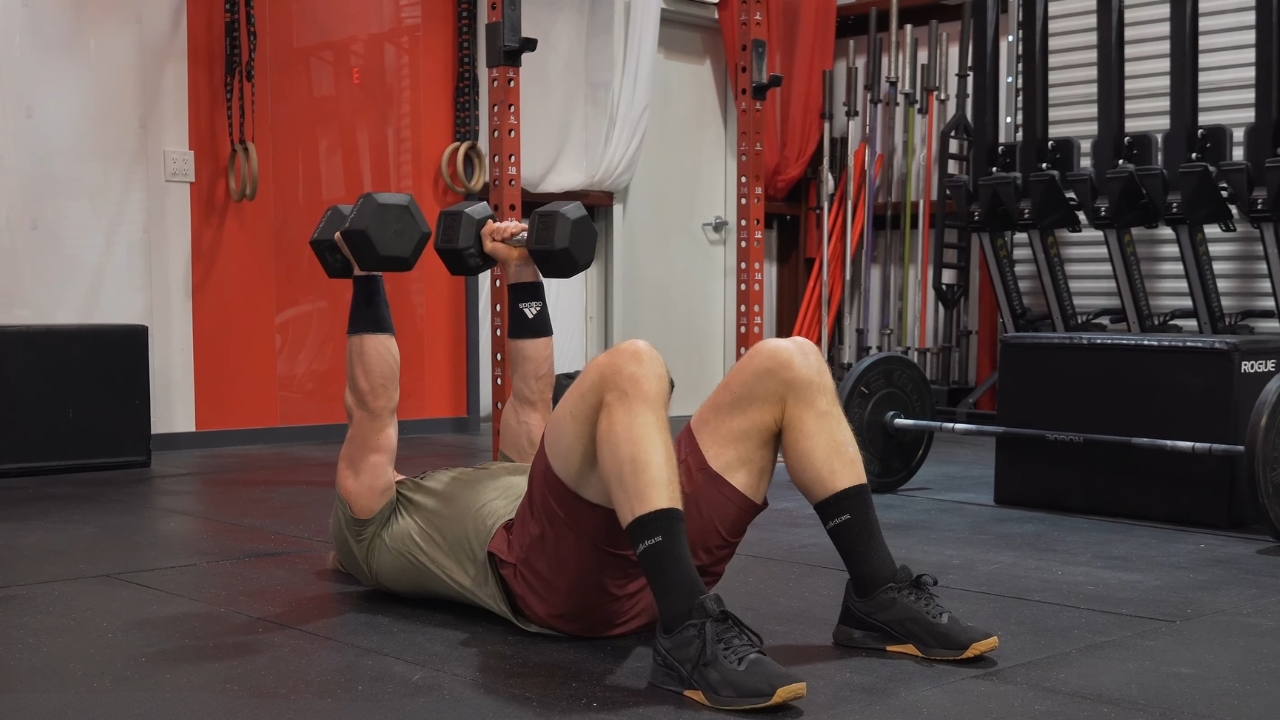
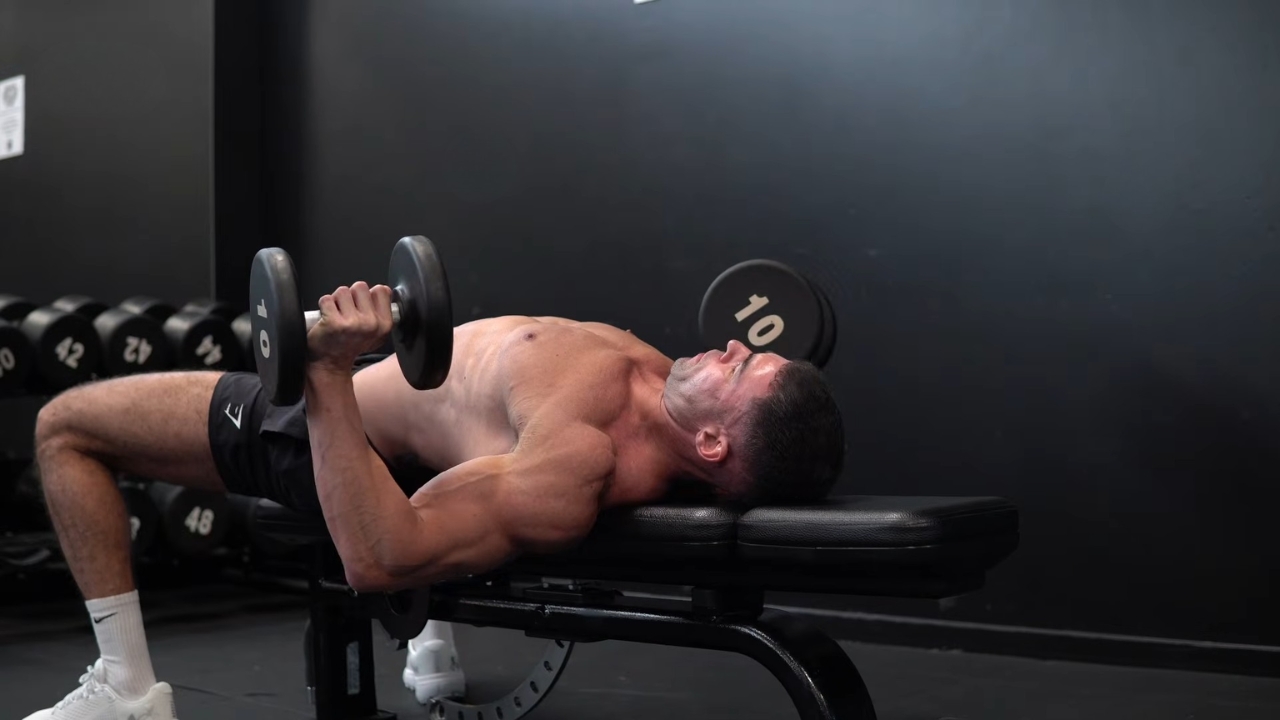
The main difference from a conventional dumbbell bench press is the shorter range of motion. Your upper arms contact the floor before your elbows can travel behind your torso, limiting the deep bottom position.
For beginners, we see that limitation as a useful feature. It removes one variable from an exercise that already requires coordinating two independently moving weights.
If you’re training at home, our dumbbell chest workout without a bench shows how to build a complete session around the floor press.
Why We Like the Floor Press for Beginners
The most difficult part of a dumbbell chest press to learn is usually the bottom position.
As you lower two dumbbells, you need to control your shoulder movement, keep your wrists aligned, and prevent your elbows from drifting into uncomfortable positions. A conventional bench press also requires you to judge how deep to lower the weights.
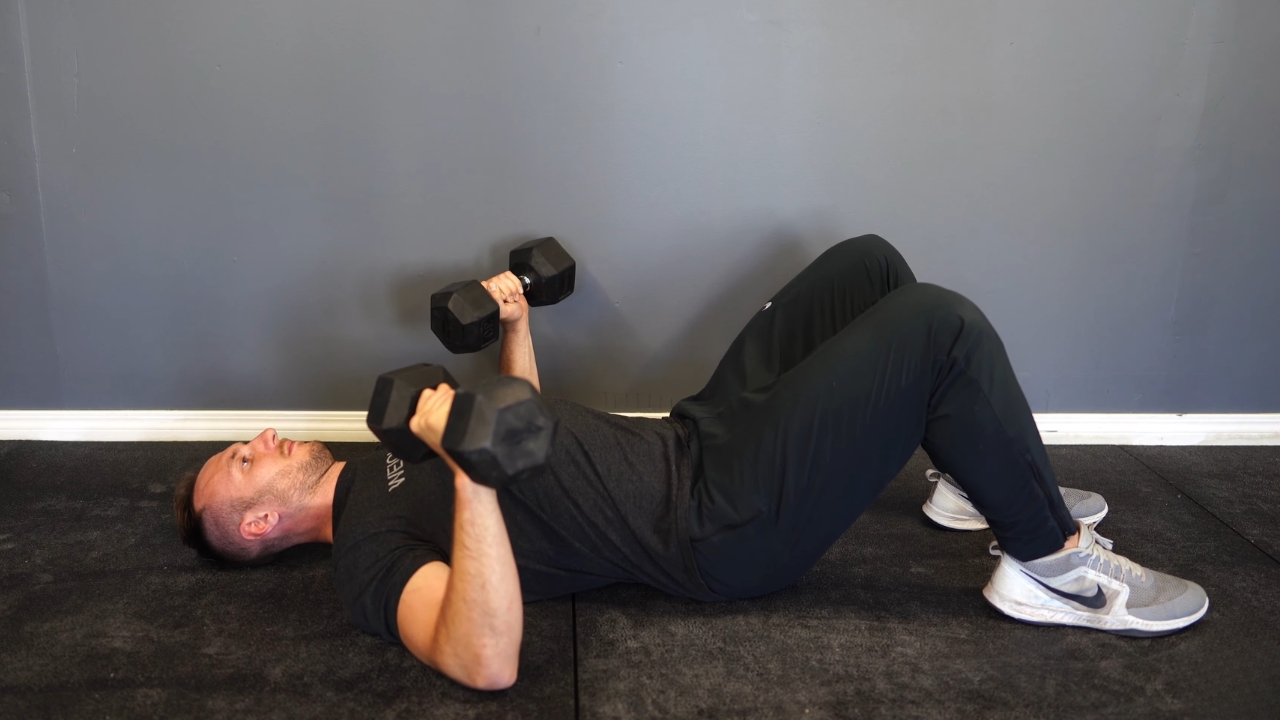
The floor press gives you a physical reference point.
Once your upper arms gently touch the ground, the lowering phase is complete. You can concentrate on keeping the dumbbells balanced and pressing them upward along a consistent path.
The floor also limits shoulder extension. Your upper arms cannot travel as far behind your torso as they can during a deep bench press. That shorter movement can be more comfortable for people who dislike the bottom position of conventional pressing, although it doesn’t guarantee a pain-free exercise.
We particularly like how easy it is to recognize a controlled repetition. Both upper arms touch down, the dumbbells remain balanced, and the next press begins without bouncing.
Those are useful habits to develop before handling heavier weights on a bench.
What Muscles Does the Dumbbell Floor Press Work?
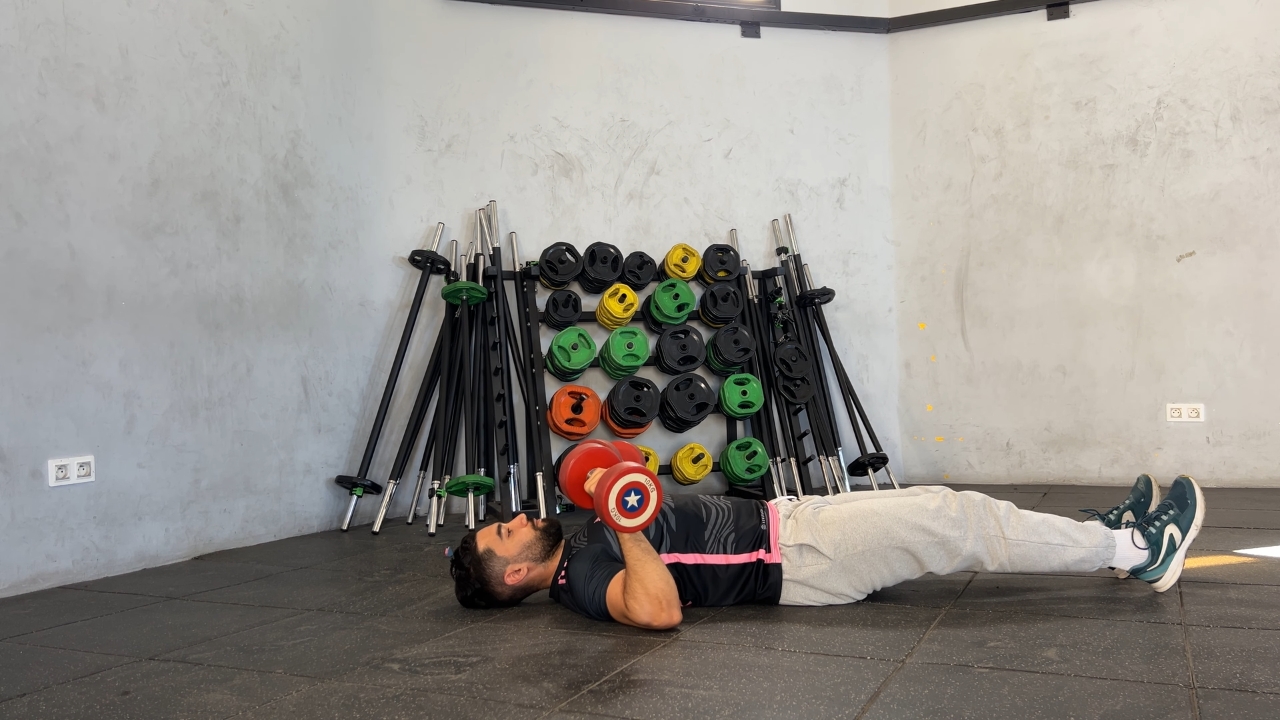
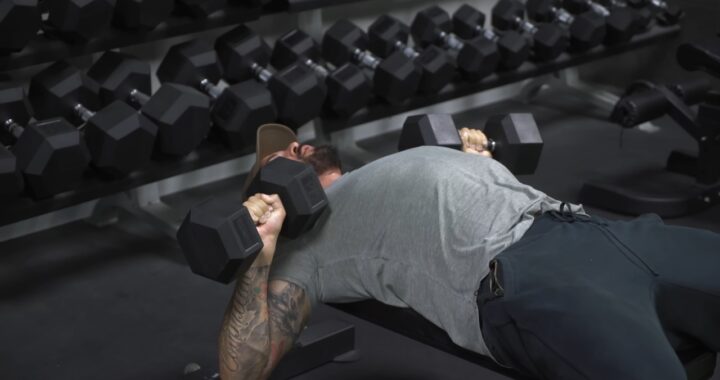
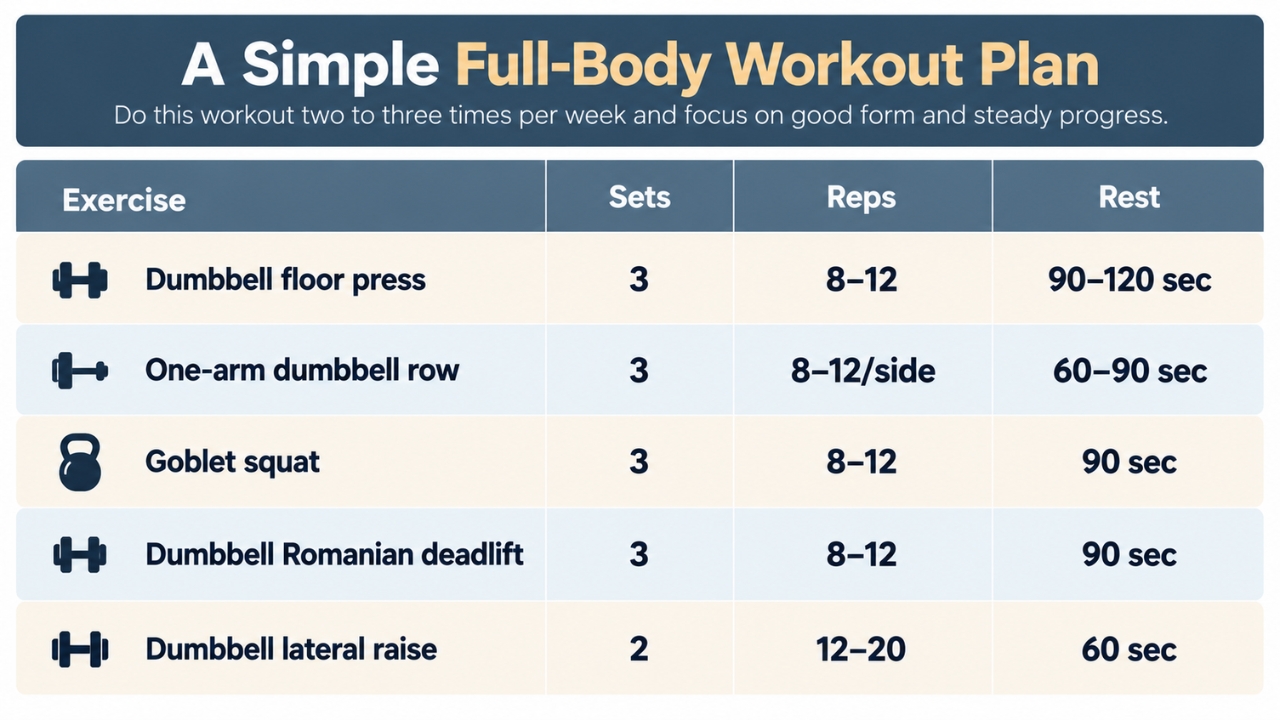
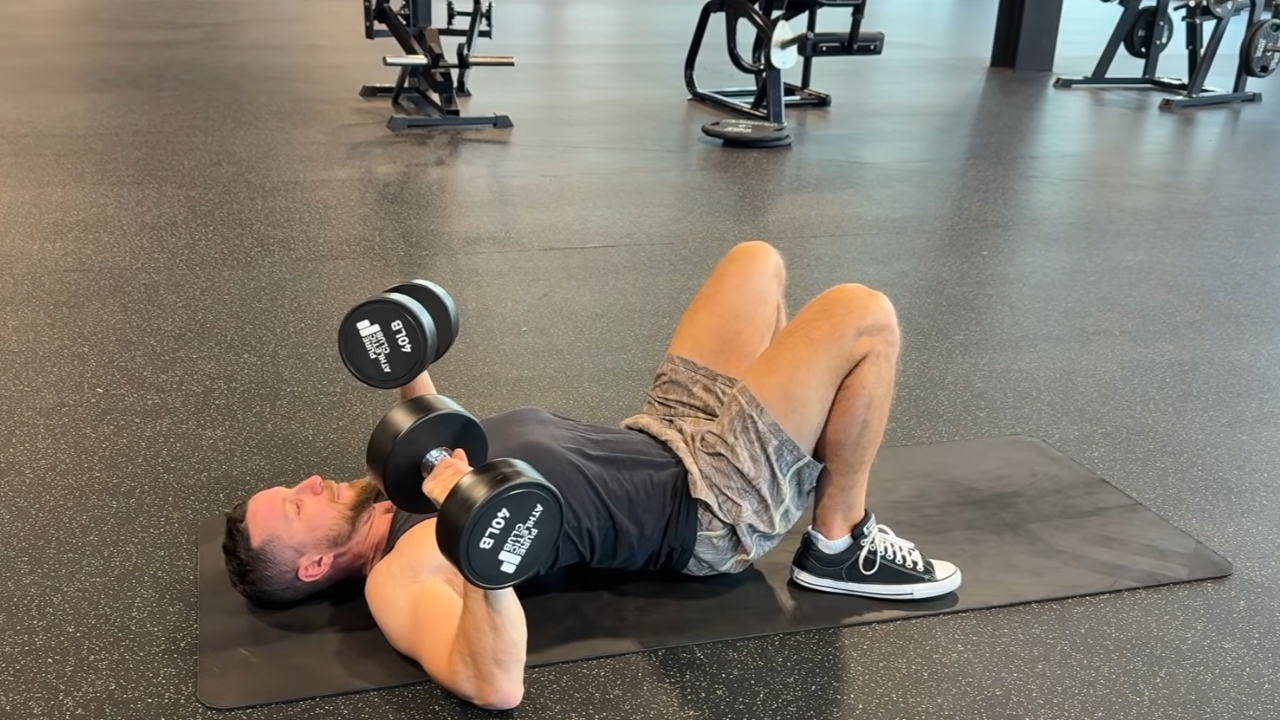
Your abdominal muscles and upper back also contribute to keeping your torso stable. During a conventional dumbbell bench press, your elbows can travel below your torso. That places the chest under load in a more lengthened position. During a floor press, the ground interrupts that movement. Your chest still contributes strongly to the exercise, but it receives less loading in the deepest stretched position. A systematic review of resistance-training range of motion found advantages for full-range training in certain strength and hypertrophy outcomes, particularly lower-body muscle growth. Those findings support considering range of motion when selecting exercises, although they don’t establish that a dumbbell bench press will outperform a floor press for every person. Our preference is straightforward. Use the floor press to establish control and build pressing strength. Introduce longer-range pressing when your equipment, mobility, and training goals make it worthwhile. After your final repetition, lower the weights toward your sides and set them down carefully. Avoid releasing dumbbells above your chest or face. We prefer a neutral or semi-neutral grip for beginners, with the palms facing each other or turned slightly forward. This allows your elbows to remain at a comfortable angle from your torso. An angle somewhere around 30–60 degrees is a reasonable starting point, although your anatomy and grip will influence the exact position. As you lower the dumbbells, think about keeping your elbows underneath your hands and your forearms nearly vertical. During the press, your hands should travel upward and slightly toward one another. Keep your wrists relatively straight instead of letting the weight bend them backward. At the top, straighten your arms without forcefully snapping your elbows into lockout. The movement should feel controlled through your chest and arms. If you experience sharp shoulder pain, stop and reassess the exercise rather than forcing the movement. Your first goal is to make every repetition look consistent. We recommend beginning with dumbbells you can press for approximately 8–15 repetitions while maintaining the same movement from start to finish. Choose a weight that allows you to control the descent, touch the floor gently, and press upward without twisting your torso or changing your elbow position. For most beginners, finishing a set with approximately one to three good repetitions remaining is a practical starting point. A systematic review comparing failure and non-failure training found that reaching muscular failure isn’t necessary for improving strength or muscle size. There’s little reason to push a new exercise to the point where you lose control of the dumbbells. Once you can perform every repetition confidently, start increasing the effort. We recommend training the floor press twice per week initially, leaving recovery time between sessions. You can include it in an upper-body workout or use it as the primary chest movement in a full-body routine. Here’s a simple starting structure. Pairing the press with single-arm dumbbell rows gives you a pulling movement to complement your chest work. Our 3-day dumbbell workout provides another way to organize your weekly training. We also cover a two-day full-body approach in our article on the 2026 home strength training guidelines. We prefer a simple double-progression method. Start with three sets of eight repetitions using a weight you can control. Keep the same dumbbells as you gradually build toward three sets of twelve. For example: These numbers illustrate the progression. Actual improvements won’t necessarily occur every session. Once you can complete all three sets of twelve with consistent technique and the intended effort, increase the dumbbell weight. Your repetitions may drop back toward eight. Build them up again. Rest around two minutes between challenging sets, extending that if necessary to maintain performance. Our guide to rest periods between dumbbell exercises explains why more recovery can improve the quality of heavier sets. Research comparing different resistance-training loads also shows that muscle growth is possible with lighter and heavier weights when training provides sufficient stimulus. Heavier loads generally have a clearer advantage for maximal strength. Our analysis of light dumbbells and muscle growth explores the practical implications for home training. One reason we recommend the floor press early is that the stopping point makes inconsistencies easier to recognize. Consider what happens when one arm starts lowering faster than the other. One upper arm touches the floor first. The second dumbbell is still moving downward. The difference becomes immediately apparent. You can also notice when the dumbbells drift toward your head, your wrists bend excessively, or your elbows begin moving at different angles. The floor doesn’t correct those mistakes automatically. It gives you a reliable reference for identifying them. Our favorite cue is to make both upper arms touch down at approximately the same time. Then press upward smoothly, keeping the weights moving at similar speeds. If one side consistently struggles, reduce the weight and concentrate on controlling the entire repetition. You can also practice a lighter single-arm variation to become more familiar with each arm’s pressing path. Both exercises train your chest, triceps, and front shoulders. The biggest practical difference is how far your upper arms can travel during the lowering phase. For someone training with limited home equipment, the floor press can remain a valuable exercise for years. It allows substantial loading, is easy to repeat consistently, and gives the triceps and chest plenty of work. However, if maximizing chest development is your priority, we recommend eventually learning the flat dumbbell press. The longer available range gives you an additional stimulus, particularly when the chest is lengthened. There’s also room for both exercises in the same training program. We’d move to a bench once the basic floor press feels predictable and controlled. You should be able to: At that point, the bench press introduces a new challenge: controlling the dumbbells through a deeper bottom position. Start with lighter weights than you use for the floor press. Keep your shoulder blades comfortably stable against the bench, maintain control as your elbows travel below your torso, and lower only as far as your shoulders comfortably allow. Don’t assume you need to reach the deepest possible position immediately. The floor press doesn’t become useless because you learned another exercise. The floor press has a built-in restriction that becomes more relevant as your chest training progresses. Your upper arms cannot travel below the floor. Consequently, the pectoralis major experiences less loading in a lengthened position compared with a deeper dumbbell bench press. A 2023 systematic review of range of motion examined how different movement ranges affect muscle growth. Its findings suggest that training at longer muscle lengths can be beneficial, although results vary across muscles and exercises. That evidence gives us a reason to include longer-range movements when chest hypertrophy becomes a priority. It doesn’t mean your chest stops growing from floor presses. You can continue increasing resistance, improving your repetitions, and generating meaningful muscular tension. We simply wouldn’t make the floor press our only chest exercise indefinitely if a bench and additional pressing options were readily available. Small technique problems can make an otherwise straightforward exercise awkward. Here are the mistakes we’d address first. Lowering too quickly causes your upper arms to hit the ground before your muscles have fully controlled the descent. Think about taking approximately two seconds to lower the weights. Let your upper arms make gentle contact, then reverse the movement. You should determine when the dumbbells stop, rather than allowing gravity to decide. Excessive wrist extension makes the dumbbells more difficult to stabilize. Keep the handles resting firmly in your palms with your knuckles pointing approximately toward the ceiling. The weight should remain supported over your forearm as you press. If your wrists repeatedly collapse backward, use lighter dumbbells. Positioning your upper arms directly out from your shoulders creates a very wide pressing position. We prefer allowing the elbows to travel somewhat closer to your torso. A neutral or semi-neutral grip usually makes this easier. Keep your elbows underneath your hands while lowering, and allow your upper arms to move through a comfortable path. Fast repetitions become a problem when you lose control at the bottom. Lower the weights deliberately, pause briefly as your upper arms touch the floor, and press upward with intent. You can press forcefully while maintaining control. The important part is keeping the same movement pattern throughout the set. Progressive overload requires increasing the challenge over time, but more weight is useful only when you can manage it. If heavier dumbbells cause your wrists to bend, your torso to twist, or your elbows to crash into the ground, return to the previous load. Build your repetitions first. A slightly lighter floor press performed consistently is more productive than a heavier set that changes into a different exercise halfway through. For someone starting dumbbell chest training, we’d put the floor press near the top of the exercise list. It gives you a stable position, a repeatable bottom point, and a practical way to build pressing strength with minimal equipment. Our recommendation is to spend several weeks getting comfortable with the movement. Keep your wrists aligned, lower both weights under control, and gradually add repetitions or resistance. Once that technique becomes reliable, explore a regular bench press if you have access to one. You can eventually introduce the incline dumbbell press, where bench angle and upper-arm position change the mechanics of the exercise. There’s no need to rush through those progressions. A good chest-training program begins with exercises you can perform consistently, challenges you can manage, and a clear way to progress. The dumbbell floor press handles all three particularly well for beginners.
How the Shorter Range of Motion Changes the Exercise
How to Do a Dumbbell Floor Press
You don’t need an elaborate setup.
What Your Elbows and Wrists Should Be Doing
Start Lighter Than You Think You Need
A Simple Floor Press Starting Plan
How to Progress Your Floor Press
The Floor Makes Bad Reps Harder to Hide
Floor Press vs. Dumbbell Bench Press
Floor Press
Bench Press
Equipment
Dumbbells + floor
Dumbbells + bench
Setup
Very simple
Slightly harder
Bottom position
Upper arm stops on floor
Elbow can travel below torso
Range of motion
Shorter
Longer
Beginner-friendly
Excellent
Good
Chest stretch
Limited
Greater
Home training
Excellent
Requires bench
Long-term chest training
Useful
Usually better
When Should You Move to a Bench?
One Limitation You Should Know About
Common Floor Press Mistakes
Dropping the Arms Into the Floor
Letting the Wrists Fold Back
Flaring the Elbows Straight Out
Turning Every Rep Into a Speed Contest
Adding Weight Before You Own the Exercise
We’d Teach the Floor Press First