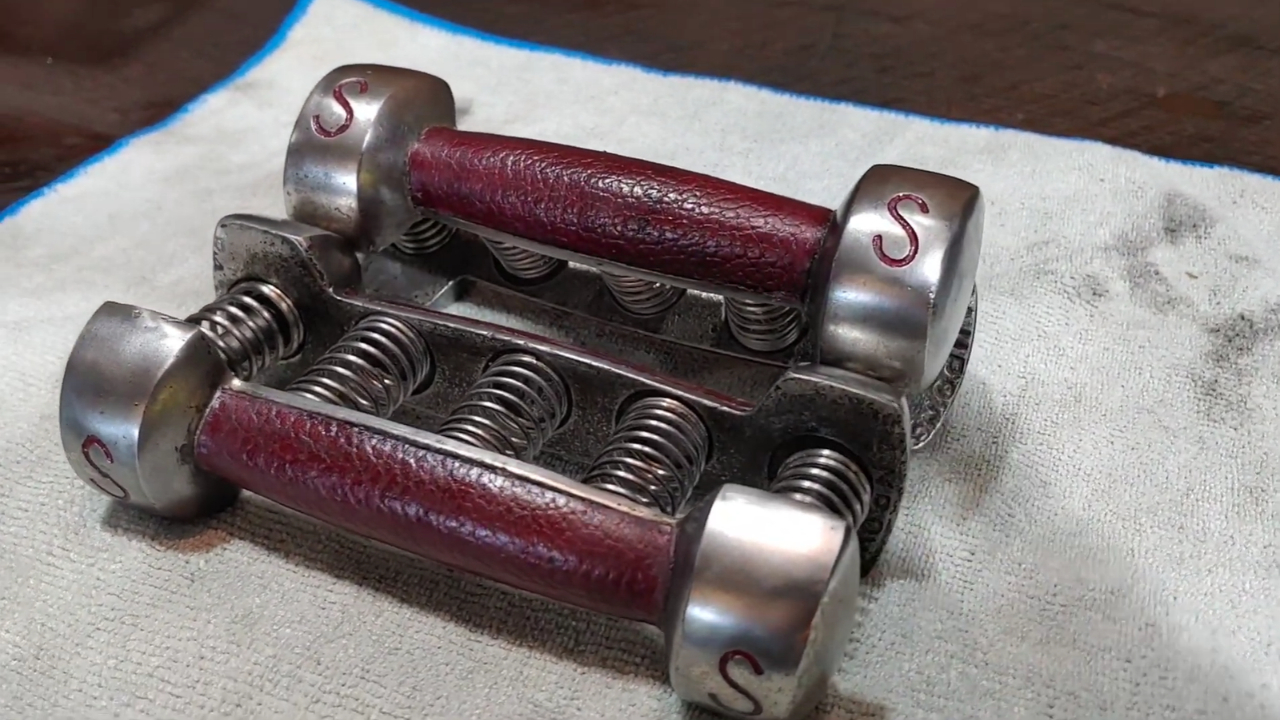
More than a century ago, Eugen Sandow sold dumbbells with handles that actively resisted your grip. Every repetition required users to squeeze against springs while lifting the weight.
Sandow believed this design could improve muscular effort and make his training system more effective.
We think his invention deserves attention for a different reason. It reveals an early attempt to solve a problem that remains familiar in strength training: how to make people exercise with greater intention.
The equipment was clever. Sandow’s claims about what it could accomplish deserve considerably more scrutiny.
These Weren’t Ordinary Dumbbells
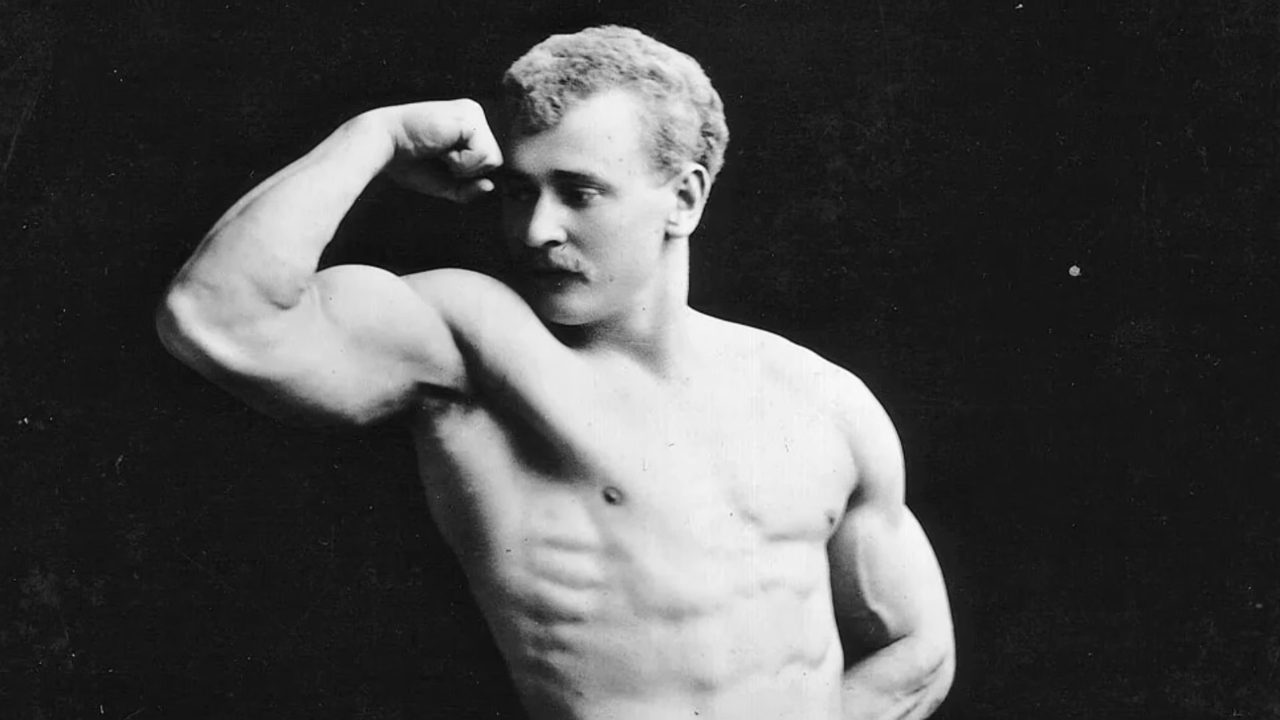
Eugen Sandow was among the most influential figures in early physical culture. He built his reputation through strongman performances, muscular exhibitions, exercise publications, and training institutes.
In 1901, he organized a landmark bodybuilding competition at London’s Royal Albert Hall. He also recognized the commercial potential of selling people a complete approach to physical development.
His spring-grip dumbbells became part of that business.
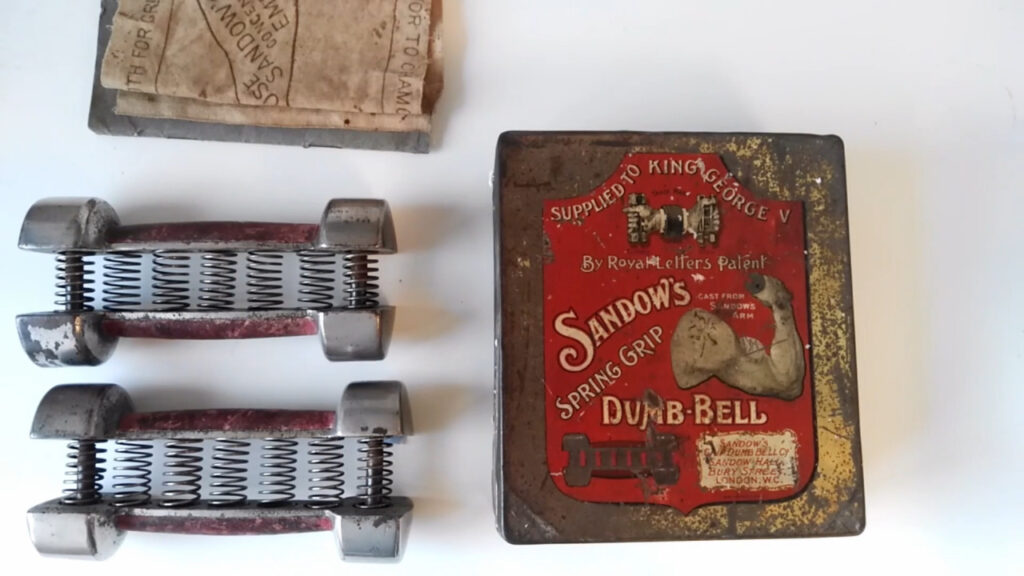
The Smithsonian’s National Museum of American History preserves an original example featuring seven springs, a surrounding handle, and screws holding the assembly together.
The original metal box carried an illustration of Sandow’s muscular arm and a statement that the equipment had been supplied to King Edward VII.
That detail tells us something about Sandow’s marketing instincts. He connected his name, physique, and social prestige to a product that promised to improve the way ordinary people exercised.
His equipment was an early example of fitness products being sold through personal authority and celebrity.
How Did the Spring-Grip Dumbbell Work?
Sandow explained the mechanism in his book, Strength and How to Obtain It.
The dumbbell consisted of two sections separated by approximately an inch and a half. Springs pushed the sections apart, requiring the user to squeeze them together during exercise.
That created two simultaneous demands:
- Grip resistance: The hand and forearm muscles worked against the springs.
- External resistance: The dumbbell’s weight challenged the muscles responsible for lifting and controlling it.
Sandow continued developing the design.
His 1900 dumbbell patent described an elastic, compressible gripping mechanism fitted around a dumbbell handle.
A subsequent improvement, patented in 1917, incorporated shaped gripping surfaces intended to distribute pressure across the fingers, palm, and thumb.
The underlying concept remained consistent: the user maintained muscular tension in the hand while performing conventional weightlifting movements.
The design had a genuine mechanical purpose. Whether that additional demand improved the intended exercise is a separate question.
Sandow Wanted to Make Half-Hearted Repetitions Harder
Sandow placed considerable importance on concentration.
He argued that people frequently performed exercises without sufficient mental involvement. Someone distracted by work or personal concerns might move through a routine with little deliberate effort.
His spring-grip dumbbells were intended to impose a minimum amount of muscular work.
The springs demanded continuous squeezing, giving users a physical task that required attention throughout the exercise.
Sandow also promoted interchangeable springs as a progression method. Users could increase the resistance of the grip mechanism as their strength improved.
We find this aspect of the invention particularly interesting.
Sandow had identified a behavioral problem and tried to address it through equipment design. He wanted the dumbbell itself to encourage more deliberate exercise.
Our objection concerns the assumption behind that approach: greater total effort during an exercise does not guarantee greater stimulation of the muscles the exercise is supposed to develop.
That distinction determines how useful the invention actually was.
Did Sandow’s Dumbbells Actually Build More Muscle?
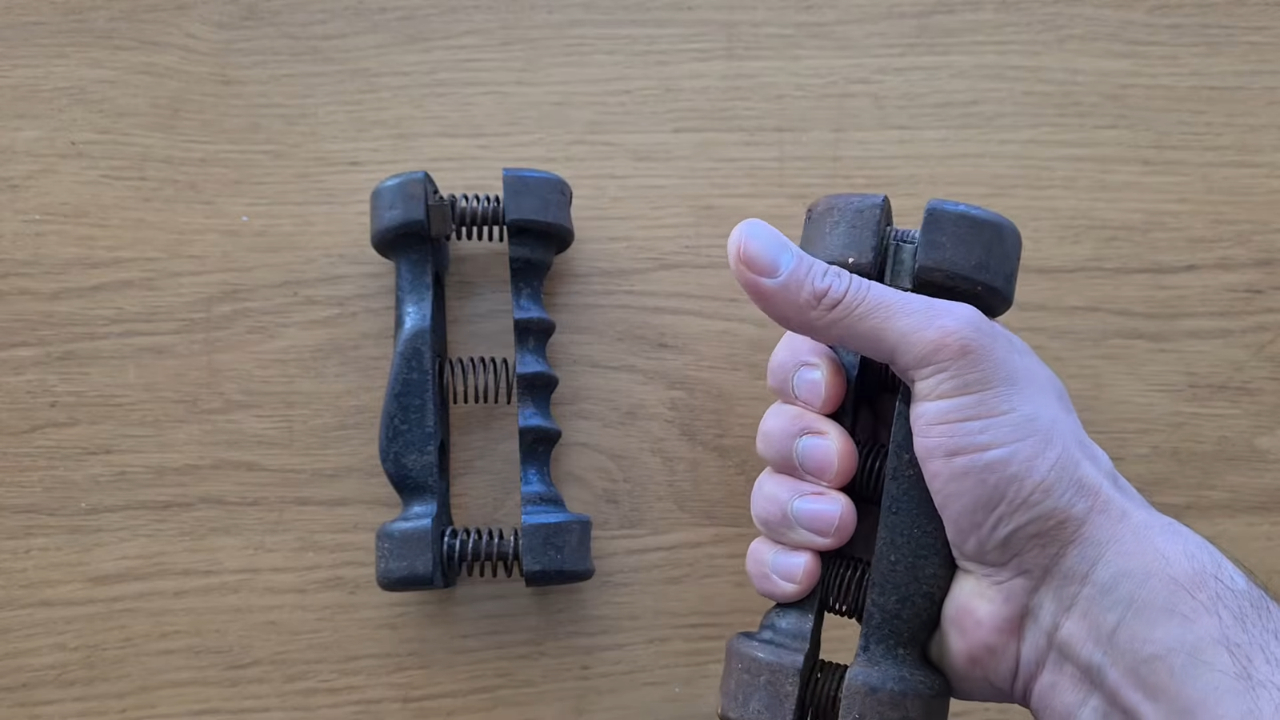
The additional spring resistance would have created work for the muscles responsible for gripping the handle.
That provides a plausible reason to expect some benefit for grip strength and forearm conditioning.
The argument becomes weaker when extended to whole-body muscle development.
Consider a dumbbell curl.
The elbow flexors must generate sufficient torque to lift the weight. Squeezing a spring-loaded handle adds a separate gripping demand, with relatively little reason to expect a meaningful increase in the resistance experienced by the biceps.
The same issue applies to lower-body exercises. During a dumbbell squat, stronger springs could fatigue the hands while leaving the resistance imposed on the quadriceps largely unchanged.
We have previously examined how lighter dumbbells can build muscle when sets provide a sufficiently challenging stimulus.
The critical issue is whether the intended muscles receive enough mechanical loading and training volume.
Our position is straightforward: an accessory resistance mechanism has limited value when it makes the wrong muscles responsible for ending the set.
If someone’s grip fails before their back muscles are adequately challenged during a row, the grip has become a programming limitation.
Sandow’s spring-grip dumbbells may have been useful for developing the forearms. We have no convincing direct comparative evidence establishing that they produced superior overall muscle growth.
His historical explanations demonstrate his training philosophy and marketing claims. They cannot establish the equipment’s effectiveness by modern scientific standards.
What Sandow Understood About Training
Sandow’s emphasis on deliberate muscular effort remains relevant.
He recognized that exercise technique, attention, and controlled execution influence how people perform resistance training.
We agree with the importance he placed on these factors, although we think he substantially overstated the independent power of concentration.
When we evaluate a dumbbell exercise, we start with the mechanics.
During single-arm dumbbell rows, for example, we favor a stable torso position, controlled movement, and an elbow path that allows the shoulder extensors to contribute effectively.
The grip needs to remain secure throughout the set. Additional gripping difficulty serves little purpose when back development is the priority.
The same reasoning applies to dumbbell Romanian deadlifts.
We want the trainee to control the hip hinge, maintain a consistent dumbbell path, and progressively challenge the hamstrings and glutes.
A grip-intensive variation could interfere with that goal, particularly when heavier weights become necessary.
Our programming preference is to give each exercise a clear purpose.
We also favor measurable progression. Increasing repetitions, resistance, or productive training volume provides a more dependable framework for strength development than relying on subjective muscular tension.
Sandow’s approach anticipated an important coaching principle: the way an exercise is performed matters.
Modern training gives us better ways to organize that principle.
How We’d Train Forearms With Ordinary Dumbbells
For people interested in developing stronger hands and forearms, we prefer straightforward grip exercises with predictable progression.
Ordinary dumbbells provide several useful options.
| Exercise | Our Starting Recommendation |
| Dumbbell farmer’s carry | 2–3 sets of 20–40 seconds |
| Dumbbell static hold | 2–3 sets of 15–30 seconds |
| Dumbbell wrist curl | 2 sets of 10–15 repetitions |
Dumbbell Farmer’s Carry
Farmer’s carries are our preferred starting exercise for general grip endurance.
Hold a reasonably challenging dumbbell in each hand, stand upright, and walk with controlled steps.
The finger flexors maintain the grip while the trunk and upper back contribute to posture.
We include carries in our three-day beginner dumbbell workout because they provide a practical way to develop loaded carrying ability.
Increase the weight or distance gradually once the prescribed sets become manageable.
Dumbbell Static Hold
Static holds offer an even simpler option.
Stand upright with dumbbells at your sides, maintain a secure grip, and hold them for a prescribed duration.
We prefer starting with 15–30 seconds and increasing the challenge as grip endurance improves.
The exercise is easy to standardize, which makes progress relatively simple to assess.
Dumbbell Wrist Curl
Wrist curls target the wrist flexors more directly.
Sit with your forearms supported on your thighs and your palms facing upward. Allow your wrists to move through a comfortable range, then raise the weights under control.
Use relatively light dumbbells and avoid swinging.
We generally recommend placing dedicated forearm work near the end of a workout. This reduces the likelihood of grip fatigue interfering with exercises that require heavier weights.
For most beginners, a few focused sets are a sensible starting point. Additional volume should earn its place through progress and recovery.
The Part of Sandow’s Invention Worth Remembering
View this post on Instagram
Sandow’s spring-grip dumbbells illustrate how creatively early physical-culture advocates approached resistance training.
He recognized the importance of muscular effort, experimented with equipment design, and developed a product that combined gripping resistance with conventional dumbbell movements.
We appreciate that ingenuity.
We also think the invention demonstrates a recurring weakness in fitness equipment marketing: treating additional muscular effort as evidence of a better exercise.
Our preference remains conventional dumbbells, appropriately selected movements, and systematic progression.
Sandow’s enduring contribution was his enthusiasm for making physical training accessible and purposeful. His spring-grip dumbbells offer an intriguing chapter in that history, along with a useful reminder to evaluate every training device according to the specific adaptation it can produce.