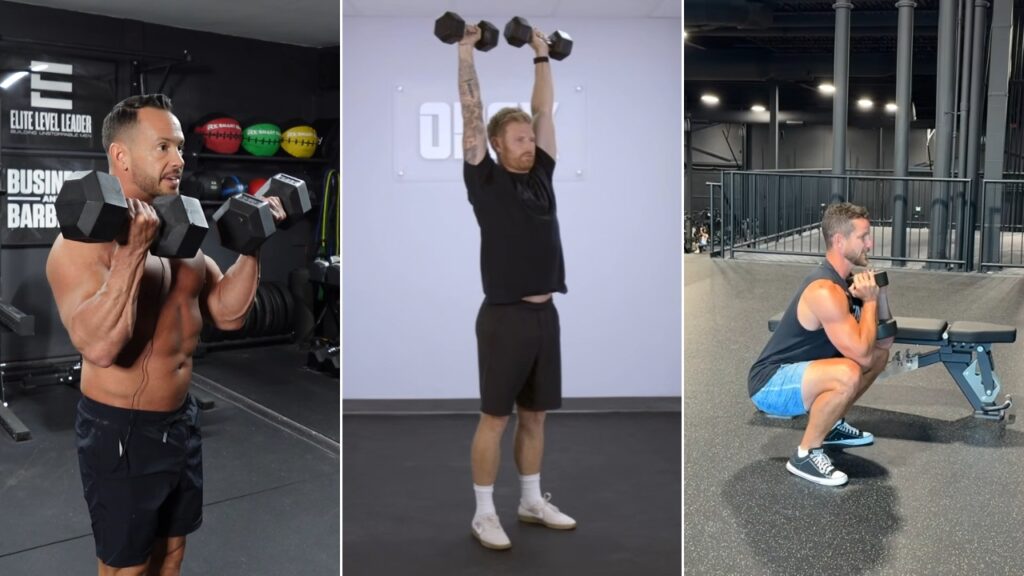
Three dumbbell workouts per week are enough to build strength, develop muscle, and learn the movements that make resistance training effective. For beginners, a full-body routine performed on three nonconsecutive days is one of the most practical ways to get started.
We prefer this approach because it gives you repeated practice with squats, hinges, presses, and rows. You work the major muscle groups several times per week, and there is enough recovery time between sessions to come back ready to train.
The plan requires a pair of dumbbells, some floor space, and approximately 40–60 minutes per workout. Adjustable dumbbells are useful because different exercises require different loads, although fixed-weight dumbbells can also work.
The 3-Day Dumbbell Workout at a Glance
Train on Monday, Wednesday, and Friday, or choose another three-day schedule that gives you a recovery day between lifting sessions.
| Day | Workout | Example Schedule |
| Day 1 | Full Body A | Monday |
| Day 2 | Full Body B | Wednesday |
| Day 3 | Full Body C | Friday |
Rest days can include walking, cycling, mobility work, or complete rest. Keep demanding physical activity manageable while your body adjusts to the new routine.
The American College of Sports Medicine’s 2026 recommendations encourage training all major muscle groups at least twice weekly. Their emphasis on consistency and manageable programming fits a three-day full-body routine particularly well.
If you’re struggling to recover between sessions or finding three workouts difficult to schedule, our article about the new strength guidelines for home training explains why two weekly sessions can also produce meaningful results.
Our recommendation: Start with fewer sets during your first two weeks if you’re completely new to lifting. Establish the movements first, then work toward the full program.
Day 1: Learn the Basics
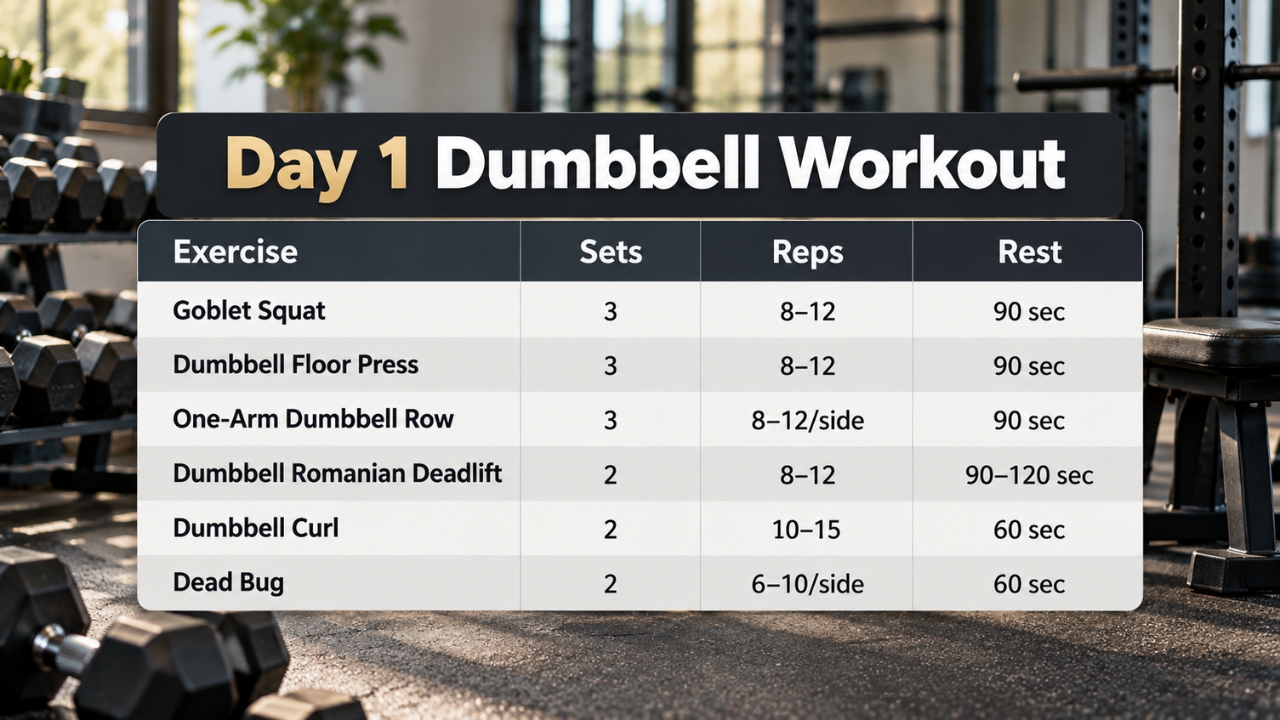
The first session introduces four essential movement patterns: squatting, hinging, horizontal pressing, and pulling. Biceps and abdominal exercises finish the workout.
How to Perform the Main Exercises
Goblet squat: Hold one dumbbell vertically against your chest and stand with your feet approximately shoulder-width apart. Bend your knees and hips together, allowing your knees to travel naturally in the direction of your toes.
Keep the dumbbell close to your body and lower as far as you comfortably can while maintaining balance. Push through your feet to stand. We like goblet squats for beginners because the weight’s position helps you learn to keep your torso balanced throughout the movement.
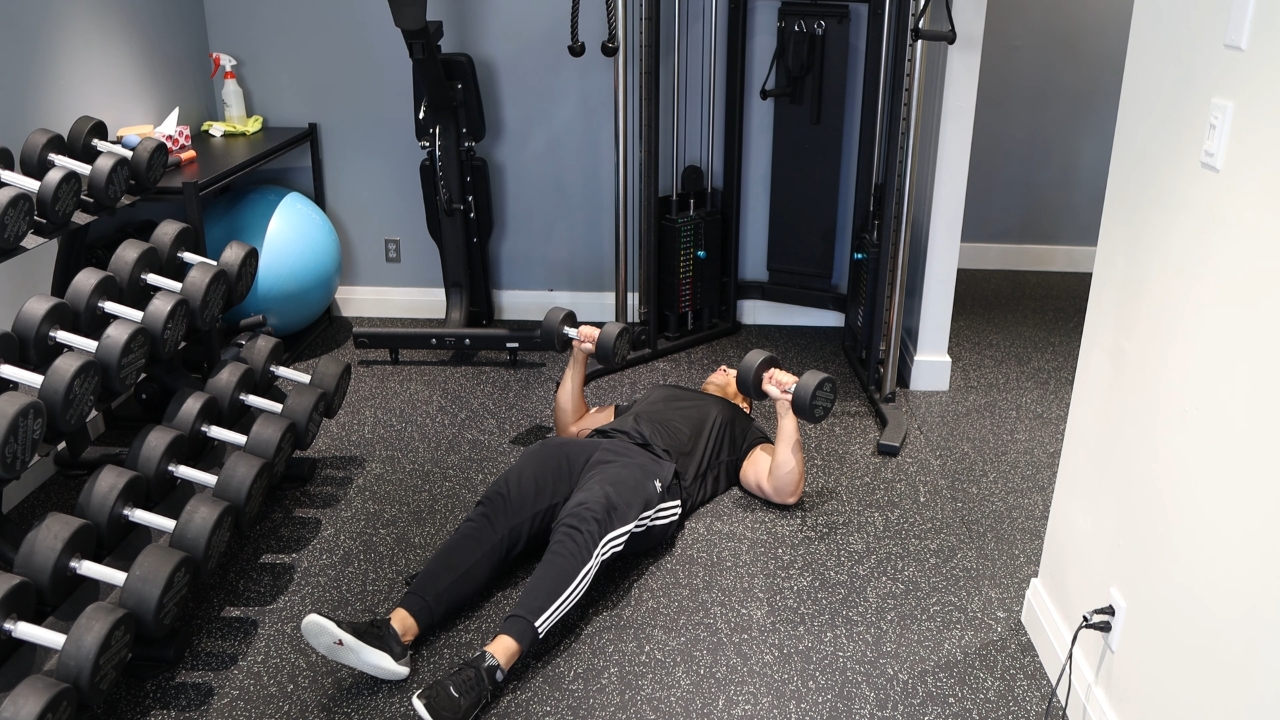
Dumbbell floor press: Lie on your back with your knees bent and feet flat. Start with the dumbbells above your chest, then lower them until your upper arms gently touch the floor.
Keep your forearms approximately vertical and your elbows at a comfortable angle from your torso. Press upward without bouncing your arms off the floor.
The floor provides a consistent stopping point. Several beginner dumbbell programs use the same exercise for that reason.
For more pressing options, see our dumbbell chest workout without a bench. If you own a bench, the flat dumbbell press allows your upper arms to travel farther below your torso, increasing the available range of motion.
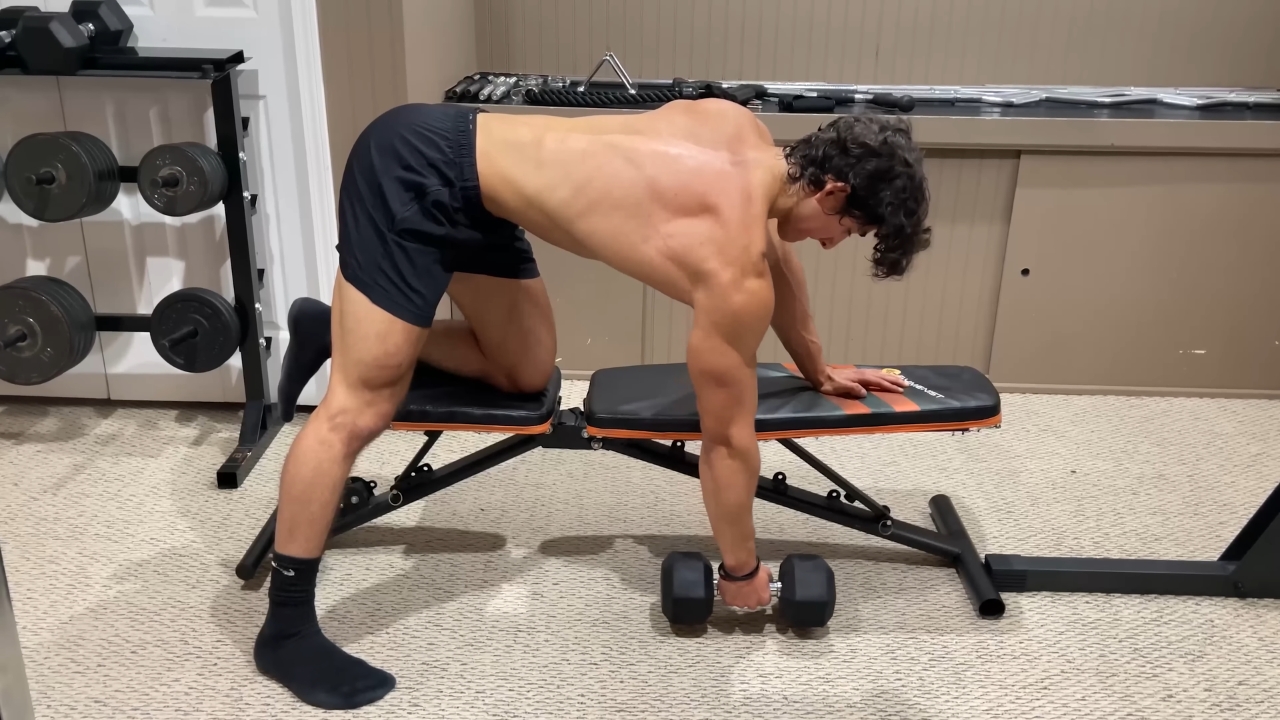
One-arm dumbbell row: Support one hand on a sturdy bench or surface. Let the working arm extend toward the floor, then draw your elbow back toward your hip while keeping your torso stable. Lower the weight until your arm is extended again.
Dumbbell Romanian deadlift: Maintain a slight bend in your knees and push your hips backward. The dumbbells should travel close to your legs as your torso leans forward.
Stop when you feel a strong hamstring stretch and can still maintain your spinal position. Stand by driving your hips forward. Our Romanian deadlift guide explains why moving from the hips is more important than trying to lower the weights to the floor.
For the curls, keep your elbows close to your sides and avoid swinging your torso. During dead bugs, extend your opposite arm and leg slowly while keeping your lower back stable against the floor.
Day 2: Same Muscles, Slightly Different Movements
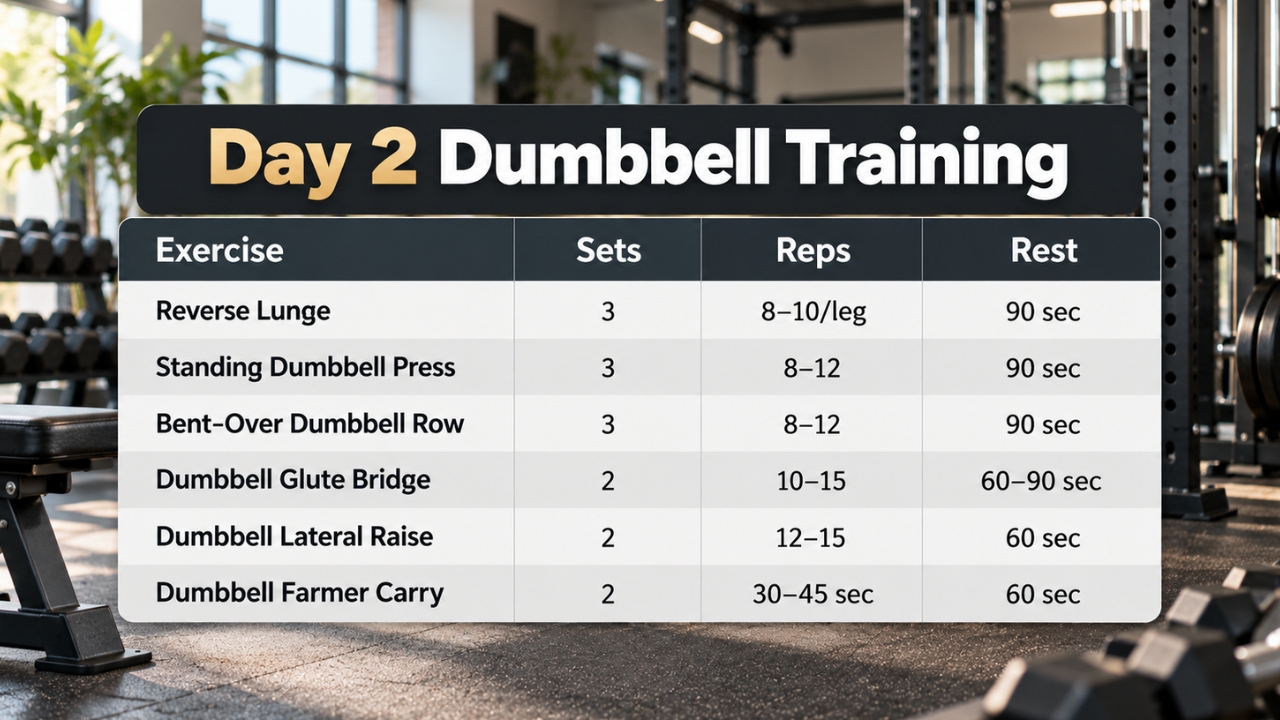
The second workout introduces unilateral leg work, vertical pressing, and exercises that challenge your trunk and shoulder stability.
We want enough variation to develop a balanced foundation while keeping the movements familiar enough to improve from week to week.
How to Perform the Main Exercises
Reverse lunge: Step backward with one leg and lower your body by bending both knees. Keep most of your weight supported by the front leg, then push through that foot to return to standing.
A slight forward lean is fine as long as your torso remains controlled. If balance is difficult, hold one dumbbell and use your free hand for light support.
Standing dumbbell press: Start with the weights beside your shoulders, keeping your wrists above your elbows.
Brace your abdomen, maintain a stable ribcage over your pelvis, and press upward until your arms extend comfortably overhead. Lower the dumbbells under control.
Watch your lower back. If you need to lean backward excessively to finish a repetition, reduce the load.
Bent-over dumbbell row: Push your hips backward and lean forward while maintaining a stable spine. Pull your elbows toward your lower ribs, then lower the weights without swinging your torso.
Your back and arms should produce the movement. Repeatedly lifting your chest to throw the dumbbells upward reduces the amount of controlled work your back muscles perform.
Finish With Glute, Shoulder, and Grip Work
For the glute bridge, place a padded dumbbell securely across your hips, keep your feet flat, and drive through your feet until your hips are extended. Avoid arching your lower back to gain extra height.
During lateral raises, lift your arms outward with slightly bent elbows until the dumbbells reach approximately shoulder height. Use a lighter weight than you would for pressing, and resist the urge to swing.
The farmer carry finishes the session.
Pick up two dumbbells, stand tall, and walk with controlled steps while keeping the weights beside your body. Your grip, trunk, and upper back work together to maintain your position.
We particularly like carries because they give beginners a practical way to experience loaded trunk stability. If your shoulders begin rounding or your posture deteriorates, end the carry.
Day 3: Repeat What Matters
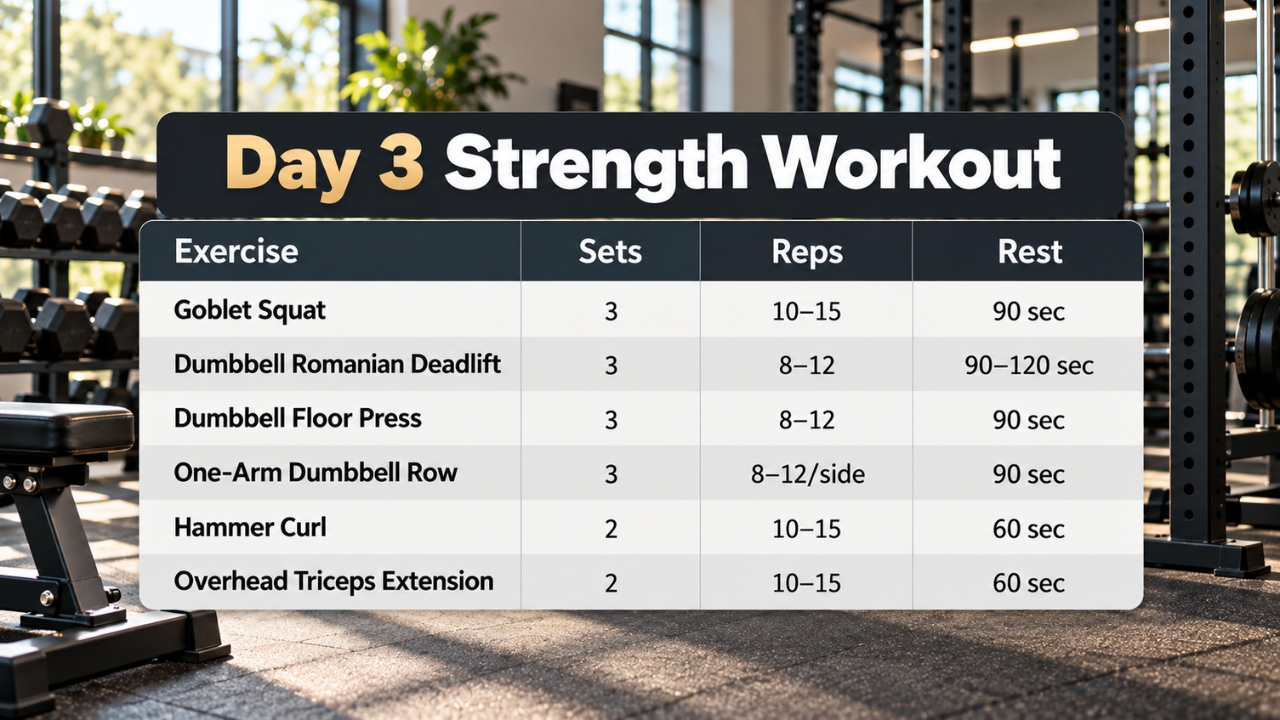
The final workout brings back several movements from Day 1, with slightly different repetition targets and additional arm work.
Repeating exercises makes your progress easier to evaluate. If you complete a movement more smoothly or perform another repetition with the same load, you have clear evidence of improvement.
Focus on better repetitions
Friday’s goblet squats use a slightly higher repetition range. Pay attention to whether your depth, foot pressure, and torso position remain consistent as fatigue builds.
For Romanian deadlifts, keep the dumbbells near your legs throughout the lowering phase. Don’t allow the weights to drift forward as you become tired.
The floor press should follow the same path on every repetition. Let your upper arms touch the floor gently, maintain stable wrists, and press without shifting your shoulders around.
For the single-arm dumbbell row, drawing the elbow toward the hip helps emphasize the latissimus dorsi. Keep your torso stable and allow your arm to extend at the bottom so the muscle works through a useful range.
Finish with hammer curls and overhead triceps extensions. Keep your upper arms relatively still during both exercises, and choose a load that lets your elbows move comfortably.
Our view is that repeating these movements for several weeks has more value than constantly adding new exercises. The goal is to become stronger and more technically consistent.
Why We Prefer Full-Body Training for Beginners
View this post on Instagram
Beginners need time to develop coordination, establish movement patterns, and build tolerance for resistance training.
Full-body sessions provide repeated opportunities to practice the fundamentals.
Consider the goblet squat. During your first few workouts, you might spend considerable effort balancing the dumbbell, controlling your descent, and finding a comfortable foot position.
After several weeks, those details should become more familiar. You can pay more attention to producing force through your legs and completing controlled repetitions.
That progression matters because strength depends partly on coordination and the ability to recruit muscles effectively.
We also prefer full-body training because the workload is distributed across the week. Your legs, chest, back, and shoulders receive regular stimulation without requiring a separate training day for each muscle group.
Other approaches, including the three-day full-body dumbbell program from Bony to Beastly, follow a similar general structure.
Exercise variety becomes more useful as your training needs develop. During the first six to eight weeks, we would prioritize consistent technique and measurable progress.
How Heavy Should Your Dumbbells Be?
Choose a load that allows you to complete the prescribed repetitions with control while making the final few repetitions challenging.
For beginners, we generally recommend finishing most sets with approximately two or three repetitions in reserve, meaning you could perform another two or three good reps before reaching your limit.
For example:
- If you complete 12 repetitions and could comfortably perform another eight, increase the load when practical.
- If you struggle to reach eight repetitions without losing your technique, reduce the weight.
- If repetitions 10, 11, and 12 require effort while your technique remains consistent, the load is probably appropriate.
Different exercises require different weights.
Your legs can typically handle considerably more resistance during Romanian deadlifts than your shoulders can during lateral raises. Trying to use the same dumbbells for both movements can make one exercise too easy or the other unnecessarily difficult.
Effort also varies from session to session. Sleep, fatigue, and expectations can affect performance. Our article about a caffeine placebo experiment provides an interesting example of how expectations can influence completed repetitions.
Look for a consistent performance trend across workouts before making major changes.
How to Progress the Dumbbell Workout
Progressive overload means gradually increasing the demands placed on your muscles as they become stronger.
We recommend a simple double-progression system: increase repetitions within a prescribed range, then increase the weight when you reach the top.
Suppose you’re performing a dumbbell floor press with 20-pound dumbbells for three sets of 8–12 repetitions.
- Week 1: 10, 9, 8 reps
- Week 2: 11, 10, 9 reps
- Week 3: 12, 12, 11 reps
- Week 4: 12, 12, 12 reps
Once you complete three sets of 12 repetitions with good control, increase the weight by the smallest practical increment.
A five-pound dumbbell jump can represent a much larger percentage increase than expected, especially with lighter weights.
Your repetitions will probably drop toward the lower end of the range. Build them back up over subsequent sessions.
That is a straightforward way to progress without constantly changing your workouts.
What If You Only Have One Pair of Dumbbells?
Limited equipment makes progression more challenging, particularly as your legs and back become stronger.
Start by adding repetitions. If your equipment is too light, you can also improve your range of motion where appropriate, use unilateral variations, and make previously rushed repetitions more controlled.
Our article about light dumbbells and muscle growth explains how lighter loads can still stimulate hypertrophy when sets are sufficiently demanding.
Eventually, heavier dumbbells may be necessary to continue developing strength efficiently.
We wouldn’t deliberately slow every repetition to an extreme degree just to make a light weight feel difficult. Controlled movement is useful, but you still need meaningful muscular resistance.
Rest Long Enough to Perform Good Sets
Rest periods influence how many quality repetitions you can complete during subsequent sets.
For smaller exercises such as curls and lateral raises, approximately 60–90 seconds is a reasonable starting point.
For demanding compound exercises, longer recovery is useful.
We recommend around 90–120 seconds initially, extending this to two or three minutes when necessary for heavier sets.
Our guide to rest between dumbbell sets explains why additional recovery can improve performance during exercises such as presses, rows, and Romanian deadlifts.
Pay attention to your breathing, grip, and overall readiness.
If your previous set required considerable effort and you’re still breathing heavily, taking another 30–60 seconds can help you maintain your next set’s quality.
Our rule: Rest long enough that the muscles you’re training become the main limiting factor, rather than general exhaustion from the previous set.
Warm Up Without Turning It Into Another Workout
@muhammadarif9696 warm up with dumbbells before start my workout? #fitness #motivate #gym ♬ original sound – kirimnalsanjay
A warm-up should prepare you for the movements and loads you’re about to use.
Start with approximately five minutes of easy movement, such as walking, cycling, or bodyweight exercises.
Then perform one or two lighter practice sets before your first demanding exercise.
For example, before goblet squats:
- Perform 8–10 controlled bodyweight squats.
- Complete 5–8 goblet squats with a light dumbbell.
- Begin your working sets when the movement feels comfortable.
You can apply the same principle to pressing and hinging exercises.
Before Romanian deadlifts, practice moving your hips backward without weights. When you add the dumbbells, concentrate on keeping them close to your legs.
For floor presses, perform several easy repetitions with a lighter pair before increasing the load.
As your working weights increase, warm-up sets become more important.
There’s no need to exhaust yourself before the workout begins. Save your hardest efforts for the working sets.
The Beginner Mistakes We’d Avoid
Beginners can make a good program unnecessarily difficult through a few common mistakes.
1. Changing exercises too frequently
Keep the main movements consistent for at least six to eight weeks.
Learning an exercise takes repetition. Changing your squat, press, or row variation every session makes it harder to measure improvement.
2. Adding too much volume immediately
The program includes multiple exercises per session, but beginners don’t need to complete every prescribed set during their first week.
If you’re new to lifting, begin with one or two sets per exercise. Build toward the full routine as your recovery and technique improve.
We would rather see three manageable workouts completed consistently than one exhausting session followed by several days of excessive soreness.
3. Using momentum to finish repetitions
Swinging the dumbbells during curls, bouncing during floor presses, and lifting your torso during rows can make heavier weights move without providing the intended muscular challenge.
Keep your technique consistent throughout each set. End the set when you can no longer perform another controlled repetition.
4. Treating soreness as proof of progress
Muscle soreness is common when you introduce unfamiliar exercises or increase training demands.
However, soreness doesn’t reliably indicate how much muscle or strength you’ve gained.
A better measure is whether your repetitions, weights, movement control, and recovery improve over several weeks.
5. Trying to recover missed workouts by doing extra sessions
Life interrupts training. Missing a workout doesn’t require doubling the next session’s volume.
Research on a 10-week training break found that previously untrained participants regained lost strength and muscle size relatively quickly after resuming training.
Long-term consistency matters more than compensating aggressively for an occasional missed workout.
FAQs
Should men and women follow different dumbbell workouts?
No. The same basic exercises are effective for both. Starting weights, training volume, and progression should reflect individual ability and goals.
Can I do cardio between dumbbell workouts?
Yes. Walking, cycling, and other cardiovascular activities can fit between lifting sessions. Adjust the intensity if they interfere with recovery.
What if I can’t do one of the exercises?
Replace it with a similar movement you can perform comfortably. For example, a supported row can replace a bent-over row if maintaining the hinge position is difficult.
Do beginners need protein powder?
No. Protein powder is a convenient way to increase protein intake, but you can meet your needs through ordinary foods.
Am I too old to start dumbbell training?
Age alone doesn’t prevent you from benefiting from resistance training. Select appropriate loads and exercises, and consult a healthcare professional if a medical condition affects safe participation.
How long before I notice results?
Some beginners notice improved coordination and strength within the first few weeks. Visible muscle growth generally takes longer, with results depending on training consistency, nutrition, and recovery.
Three Days Is Plenty to Get Started
A three-day dumbbell routine gives you enough weekly training to build strength, develop muscle, and establish proper lifting technique.
The main advantage is how easy it makes progress to track. You’re repeating the same fundamental movements, practicing them regularly, and gradually increasing the demands on your muscles.
We recommend following the plan for six to eight weeks before making substantial changes. Record your repetitions and weights, pay attention to your technique, and increase the difficulty when your performance supports it.
Start with manageable loads. Recover between sessions. Give the exercises enough time to become familiar.
A good beginner program should leave you with something measurable to improve the next time you pick up your dumbbells.