
A heavy set of dumbbell presses can make 60 seconds feel surprisingly short. You finish your first set, put the weights down, catch your breath, and suddenly it’s time to lift again. Your chest and triceps are still tired, your breathing hasn’t settled, and getting the dumbbells into position feels harder than the actual pressing.
That’s a problem if you’re trying to build strength or get more productive work out of each set.
For heavy dumbbell exercises, two to four minutes of rest between hard sets is a sensible starting point. Particularly demanding sets may justify even longer. Smaller isolation movements generally need less recovery.
At The Strength Workshop, we think rest periods deserve the same consideration as exercise selection, loading, and repetitions. Getting them right can make a noticeable difference to how consistently you train.
Short Rest Can Turn Strength Training Into a Conditioning Workout

Imagine performing three sets of dumbbell bench presses with the same pair of weights.
Your first set produces 10 controlled repetitions. After 60 seconds of rest, you manage seven. Another minute passes, and your third set ends at five.
Your muscles have certainly worked hard, but you’ve also accumulated enough fatigue to lose nearly half your repetitions.
Short rest periods increase the cardiovascular and metabolic demands of training. There are situations where that’s useful, particularly when conditioning and workout density are priorities.
For heavy strength training, though, excessive fatigue can interfere with the work you’re trying to accomplish.
A systematic review of rest intervals found that resistance-trained individuals generally benefit from resting longer than two minutes when the goal is maximizing strength gains. Beginners can make substantial progress with shorter intervals.
We’d rather see you complete another controlled set with an appropriate load than rush back to the dumbbells simply because the timer says so.
Heavy Dumbbell Exercises Create More Fatigue
View this post on Instagram
A set of lateral raises and a heavy dumbbell Romanian deadlift place very different demands on your body.
During the Romanian deadlift, your hamstrings and glutes produce substantial force while your spinal erectors stabilize your torso and your forearms hold the weights. Your ability to maintain a strong hip hinge also matters as fatigue accumulates.
Heavy presses bring their own challenges.
Before performing a flat dumbbell press, you need to position both weights, establish a stable shoulder position, control the descent, and press without losing your intended range of motion.
Every repetition requires coordination and muscular effort. Getting the weights safely into and out of position adds another demand.
A concentration curl is considerably simpler.
We’d use the following rest intervals as practical starting points:
| Exercise | Typical Rest Between Hard Sets |
| Dumbbell bench press | 2–4 minutes |
| Dumbbell Romanian deadlift | 2–4 minutes |
| Bulgarian split squat | 2–4 minutes |
| Heavy one-arm dumbbell row | 2–3 minutes |
| Dumbbell overhead press | 2–3 minutes |
| Goblet squat | 2–3 minutes |
| Dumbbell curl | 1–2 minutes |
| Triceps extension | 1–2 minutes |
| Lateral raise | 1–2 minutes |
| Rear-delt raise | 1–2 minutes |
Treat the numbers as starting points.
A challenging set of Bulgarian split squats performed close to failure might demand four minutes or more. Moderate goblet squats performed with several repetitions in reserve may require considerably less.
The load, proximity to failure, and demands of the exercise all influence how much recovery you need.
Longer Rest Helps You Keep Your Reps
One of the strongest arguments for longer rest periods is straightforward: they help preserve your performance across successive sets.
Consider a dumbbell bench press programmed for three sets of 8–10 repetitions.
With 60-second rests, your results might look like this:
- Set 1: 10 repetitions
- Set 2: 7 repetitions
- Set 3: 5 repetitions
Now imagine keeping the weight, effort, and exercise technique comparable while extending your rest to three minutes.
Your performance might improve to:
- Set 1: 10 repetitions
- Set 2: 9 repetitions
- Set 3: 8 repetitions
That’s an illustrative example, but it captures the practical difference.
You’ve performed five additional repetitions with the same weight. Your later sets also remain within the programmed repetition range.
That extra work can be valuable when progressing an exercise over several weeks.
A review on rest duration discussed how rest periods of approximately three to five minutes can help lifters maintain training intensity during demanding strength work.
There is no requirement to rest five minutes before every exercise. The useful question is whether additional recovery allows you to perform substantially better in the next set.
If another minute gives you several good repetitions, it’s probably a minute worth taking.
Longer Rest Is Especially Useful for Strength
Strength training depends heavily on your ability to produce high levels of force repeatedly.
Heavy loads already challenge your muscles and nervous system. Starting each subsequent set with substantial residual fatigue can compromise performance.
An eight-week study involving 21 resistance-trained men compared one-minute and three-minute rest intervals.
Participants resting three minutes experienced greater improvements in maximal squat and bench press strength. Greater muscle growth was also observed in the anterior thigh, with some other measurements showing less conclusive differences.
A separate 16-week trial examined rest periods of one, three, and five minutes in 36 recreationally trained men. Longer rest intervals generally produced better strength outcomes, particularly as training progressed.
Both studies used conventional resistance exercises, so their findings shouldn’t be treated as exact predictions for every dumbbell movement. The underlying principle is still relevant.
Heavy training benefits from adequate recovery between demanding efforts.
Consider a challenging incline dumbbell press.
You want enough recovery to maintain your pressing path, shoulder position, and control of the dumbbells. If fatigue forces your elbows into an awkward position or significantly reduces your repetitions, that set may have been rushed.
The same reasoning applies to the dumbbell floor press, where repeated heavy efforts still require stable positioning and controlled repetitions despite the shorter range of motion.
For anyone training at home, our bench-free dumbbell chest workout provides a practical way to organize pressing exercises without additional equipment.
Our preference for heavy sets of roughly four to eight repetitions is to begin with three minutes of rest, then adjust according to performance.
What About Rest Times for Muscle Growth?
Rest intervals become more interesting when hypertrophy is the main objective.
Traditional bodybuilding advice frequently recommended 30–60 seconds between sets. Short rests produce considerable fatigue, a noticeable muscle pump, and acute hormonal responses.
However, the pump itself tells us relatively little about how much muscle you’ll build over time.
A 2024 systematic review analyzed nine studies comparing different rest durations.
The researchers found a small potential hypertrophy advantage for longer rest periods, particularly compared with intervals of 60 seconds or less. Evidence for additional benefits beyond approximately 90 seconds remained uncertain.
That’s an important distinction.
We wouldn’t argue that three minutes of rest automatically produces substantially more muscle growth than two minutes.
Our argument is more practical.
If an extra minute allows you to perform more challenging repetitions, maintain the intended technique, or use a heavier load, it may improve the quality of your training.
For compound dumbbell movements, two to four minutes usually provides a useful working range. Smaller exercises can often be completed with shorter intervals without significant performance losses.
The objective is to accumulate productive training volume while managing fatigue.
You Do Not Need the Same Rest Time Every Set
Strict rest timers are convenient, but recovery doesn’t always happen at an identical rate.
Your first working set might leave you ready to lift again after two minutes. By your fourth set, accumulated fatigue may make three minutes more appropriate.
Heavy single-arm dumbbell rows illustrate another complication.
Your grip, upper back, and trunk all contribute to stabilizing the movement. As the sets become harder, you may need more recovery to preserve a controlled pull toward your hip without twisting your torso to move the weight.
Alternating arms also affects how you count rest. Each arm gets some recovery while the other works, so a 60-second pause after completing both sides gives the first arm more total recovery than the timer alone suggests.
Before another heavy set, check a few things:
- Your breathing has largely settled.
- Your grip feels capable of securely controlling the weights.
- You can reproduce your intended setup and range of motion.
- You expect to maintain reasonable performance.
- Your concentration has returned to the exercise.
You don’t need to feel completely recovered. Some fatigue is normal during resistance training.
However, if every new set begins with you struggling to breathe or stabilize the weights, extending the rest period is worth considering.
Rest Longer Before the Exercises That Matter Most
Exercise priority should influence how you distribute recovery time.
If your main goal is increasing your dumbbell bench press strength, giving that movement three or four minutes between working sets makes sense.
Spending the same amount of time recovering from light curls is harder to justify.
A simple upper-body session could look like this:
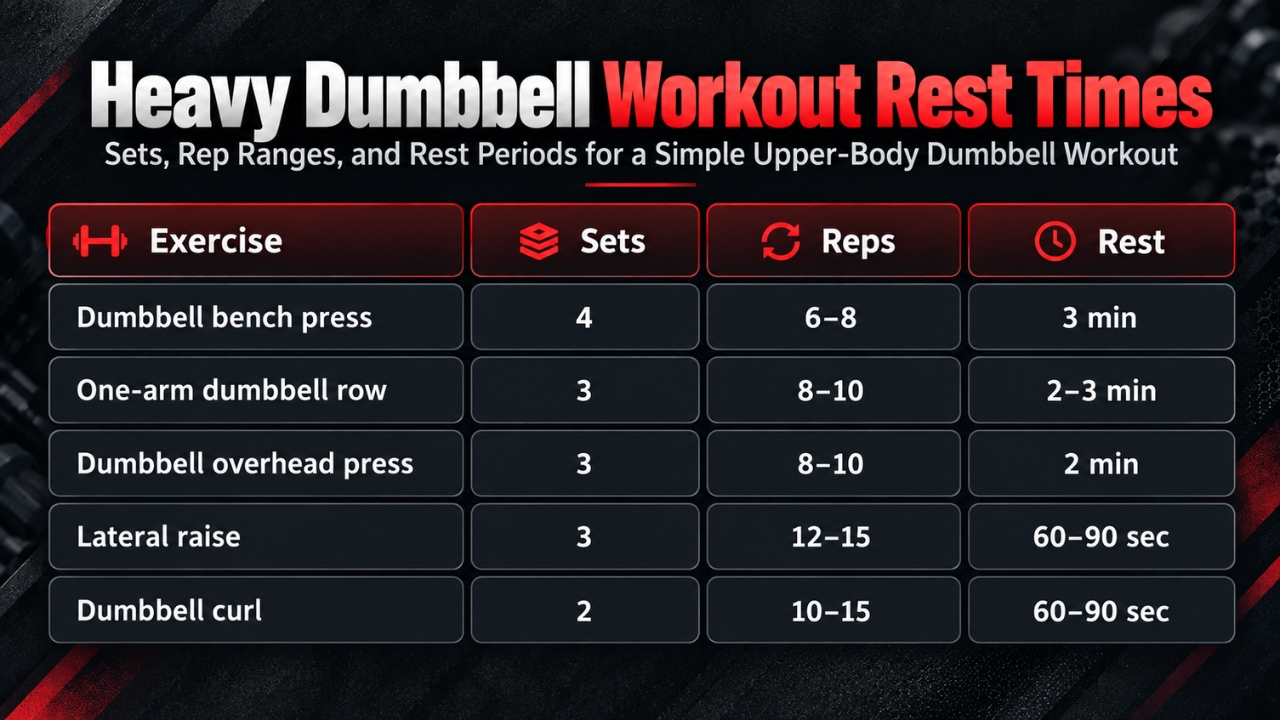
The session begins with heavier compound exercises that demand greater muscular output and coordination.
Rest periods gradually shorten as the exercises become less demanding.
We’d apply the same principle to a 3-day dumbbell workout, allocating more recovery to the primary lifts and keeping accessory work relatively efficient.
There’s another advantage to organizing sessions this way.
When your most important exercises come first, you can perform them before fatigue from other movements begins affecting your results.
When Shorter Rest Makes Sense
Longer rest periods are useful, but they shouldn’t become an excuse to make every workout unnecessarily long.
For lateral raises, curls, triceps extensions, and similar accessory exercises, approximately 60–120 seconds is often sufficient.
The absolute loads are usually smaller, and the exercises generally involve fewer joints and less overall muscular demand.
Shorter rests also make sense when time is limited or conditioning is part of your goal.
Our discussion of lighter dumbbells and muscle growth explains how lighter loads can still provide a meaningful hypertrophy stimulus when sets are sufficiently challenging.
You can also improve workout efficiency by pairing exercises that place different demands on your body.
For example, alternating curls and calf raises may let one muscle group recover while the other works.
Pairing heavy Romanian deadlifts with Bulgarian split squats is another matter. Both exercises heavily challenge your lower body, and the second movement may suffer when performed under substantial fatigue.
We prefer saving the most demanding combinations for situations where conditioning is an explicit objective.
For ordinary strength and hypertrophy training, exercise pairings should preserve the performance you’re trying to improve.
Stop Treating Rest as Wasted Time
@trainbloom How long should you rest between sets? Probably longer than you think… Resting 3 minutes produced significantly more strength AND size gains compared to resting just 1 minute in this particular study I know using short rest times gives you a better pump and makes you “feel” more tired, but neither of those things lead to more gains For a better breakdown of exactly how long you should be resting I recommend going off of what muscle groups you’re training For smaller muscle groups rest between 90-120 seconds (e.g. arms, shoulders, calves, abs, etc.) For bigger one’s (e.g. chest, back, legs, etc.) rest 2-3 minutes Remember, it’s very easy to rest too little, but very hard to rest too much And if you think you need less than a minute to make that possible, I would bet money that you’re just not lifting heavy enough Great originial video from @gymuncle ♬ original sound – Tony
A good strength workout doesn’t need to leave you gasping for air between every exercise.
Some of your most productive training minutes happen while you’re sitting on a bench, recovering enough to perform another challenging set.
We’d start with two to four minutes between heavy compound dumbbell sets, then adjust based on what happens to your repetitions, load, and technique.
If your second set loses several repetitions because you’re still exhausted, try adding another minute.
If your performance remains consistent and you’re comfortable starting sooner, there’s little reason to force yourself to wait.
Smaller accessory exercises can usually move along at a quicker pace.
Our rule is to rest long enough to give the next set a fair chance.
Your progress comes from repeatedly challenging your muscles with appropriate effort, technique, and progression. A rest period that supports those qualities is doing exactly what it’s supposed to do.