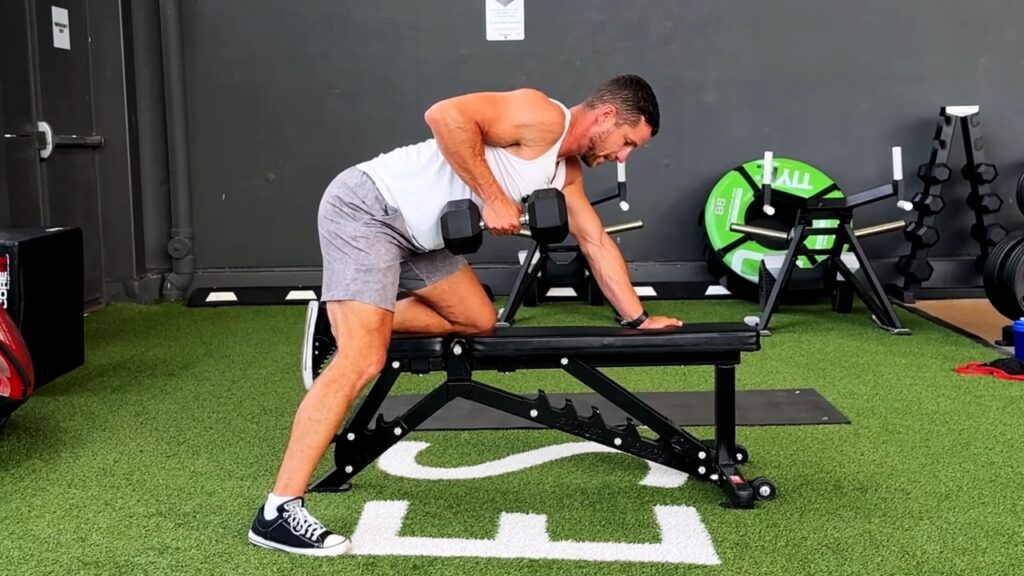
Single-arm dumbbell rows seem straightforward. Support yourself with one hand, grab a dumbbell, pull it up, and lower it again. Yet the direction of that pull can make a meaningful difference to which back muscles do more of the work.
If your main goal is building your lats, we prefer pulling the dumbbell toward your hip, with your elbow traveling relatively close to your torso. A higher pull toward your chest generally creates more involvement from the upper back and rear deltoids.
It’s a small adjustment, but one worth making deliberately.
We particularly like the cue “elbow toward your back pocket.” It gives the movement a clear destination and discourages the habit of hauling the weight upward until your shoulder and entire torso join the effort.
The dumbbell doesn’t need to finish as high as physically possible. It needs to travel through a useful range of motion that challenges the muscles you’re trying to develop.
Pulling Toward Your Hip Gives the Lats a Better Job
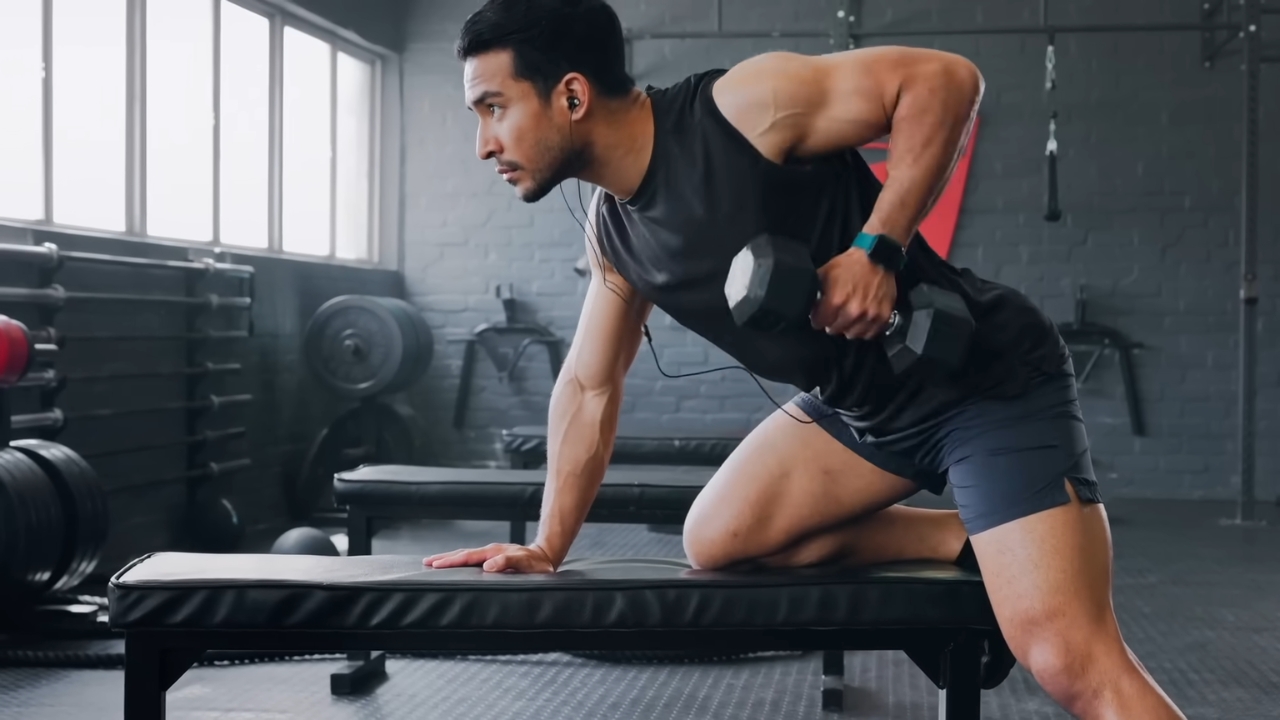
The latissimus dorsi is one of the largest muscles of the back. Among its functions are shoulder extension, adduction, and internal rotation, as described in this anatomical overview.
Shoulder extension is particularly relevant to the single-arm dumbbell row.
As you pull your upper arm backward toward your hip, your lats contribute to that movement. Keeping the elbow relatively close to the torso allows you to emphasize shoulder extension while limiting how far the upper arm moves outward.
There’s some research supporting this approach, although we should be precise about what it tells us.
A 2022 EMG study reported particularly high latissimus dorsi activation during chest-supported and prone shoulder-extension tests. Those were maximum voluntary contraction exercises, so the findings shouldn’t be treated as a direct comparison of dumbbell rowing techniques.
A more recent 2026 review of pulling exercises found that lower shoulder-abduction angles were associated with greater lat activation in some seated-row research.
The review also highlighted limitations in the available studies. Higher electrical activity during an exercise doesn’t automatically guarantee greater muscle growth over several months.
Our practical interpretation is pretty straightforward – a lower elbow path is a reasonable starting point when you want to emphasize the lats.
You still need sufficient resistance, controlled repetitions, and progressive training to make that emphasis count.
The Elbow Matters More Than the Dumbbell
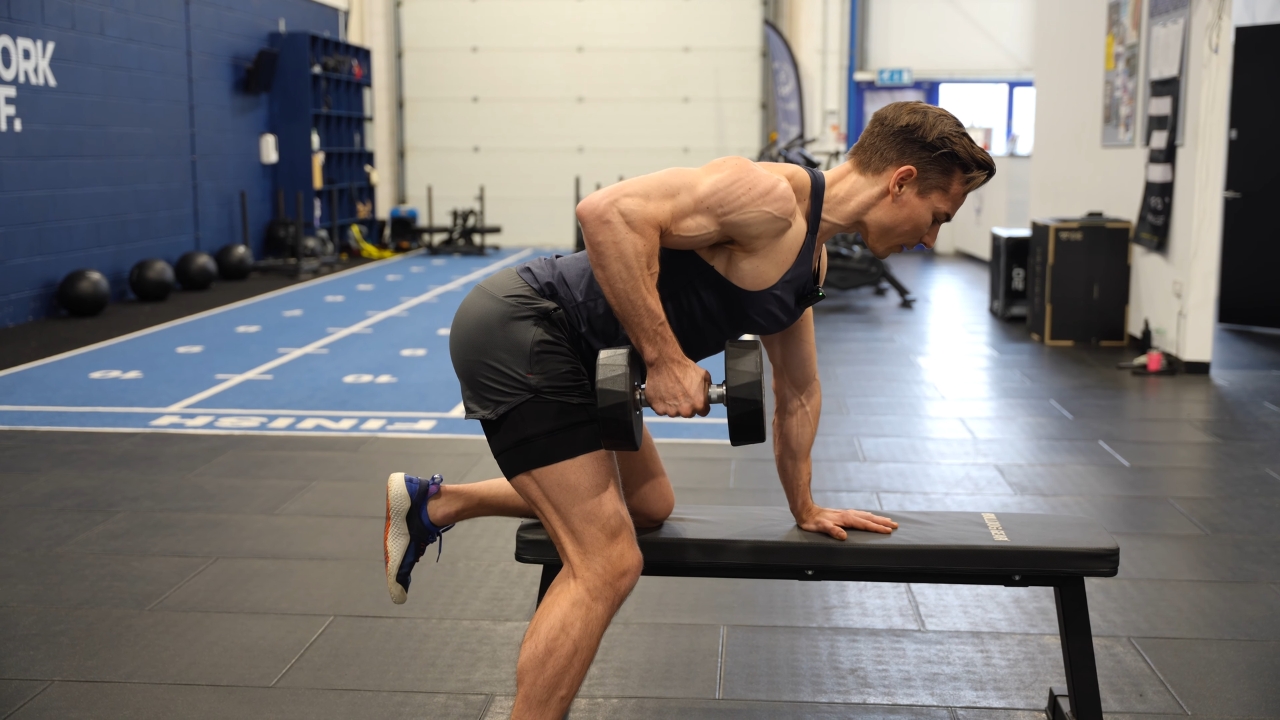
One of the easiest ways to improve a dumbbell row is to pay closer attention to your upper arm.
The dumbbell follows your hand. Your elbow provides a better indication of what’s happening at the shoulder.
For a lat-focused row, we want the elbow traveling backward toward the hip. It can move slightly behind the torso, depending on your anatomy and positioning, but there’s little reason to force it farther once the useful shoulder movement has ended.
When the elbow moves outward and upward toward shoulder height, the movement changes.
You’re introducing more horizontal abduction and typically placing greater emphasis on the rear deltoids, rhomboids, and trapezius muscles.
Both approaches can be productive.
What matters is choosing the elbow path that matches your goal and maintaining it as the set becomes difficult.
We’d much rather see ten consistent repetitions with a manageable dumbbell than ten repetitions in which the first five target the lats and the remaining five resemble increasingly ambitious attempts to start a lawn mower.
How We Perform a Lat-Focused One-Arm Dumbbell Row
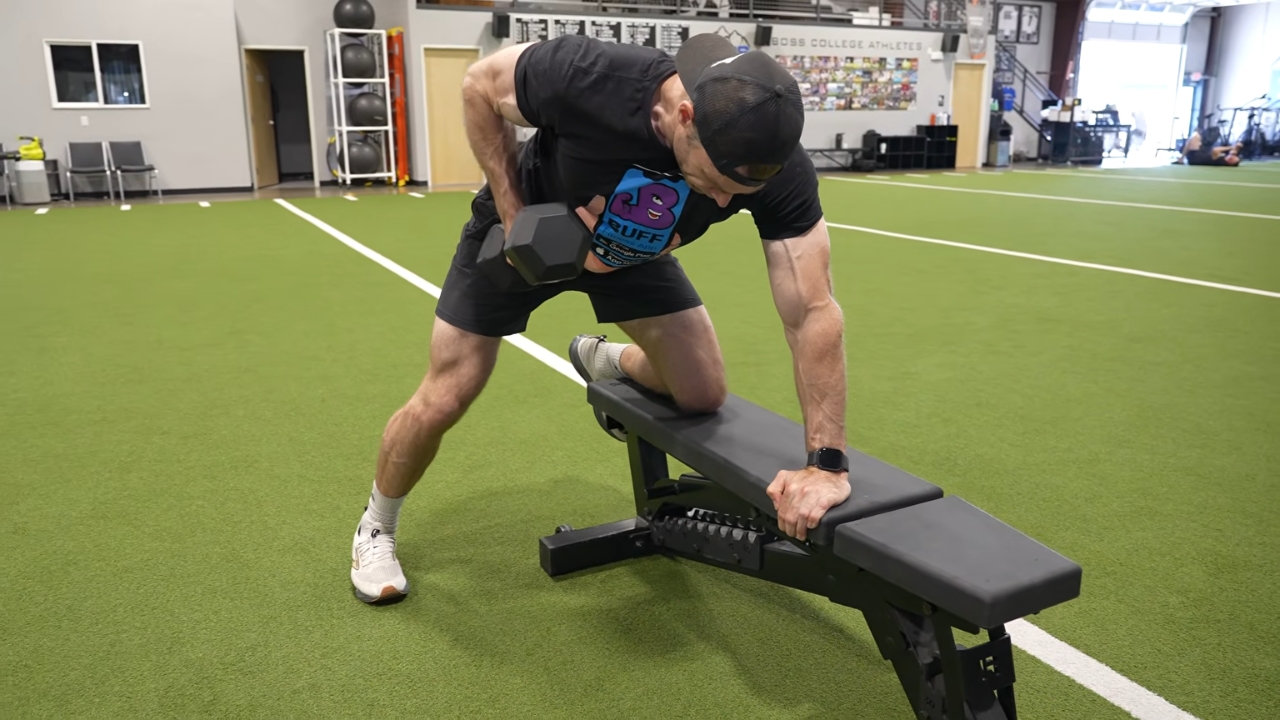
Our preferred starting position uses one hand supported on a sturdy bench or rack, with your feet staggered and your torso hinged forward.
Support makes it easier to maintain a consistent body position and concentrate on the working arm.
Your torso should be comfortably inclined toward horizontal. The exact angle can vary with your proportions and the equipment available.
Here’s how we recommend performing the movement:
- Establish your position. Place one hand on a stable support, hinge at the hips, and keep your torso relatively still.
- Let the arm lengthen. Allow the dumbbell to hang below your shoulder, with a comfortable reach at the bottom.
- Lead with your elbow. Pull your upper arm backward toward your hip while keeping the elbow reasonably close to your body.
- Avoid excessive rotation. Keep your chest largely facing the floor throughout the repetition.
- Finish naturally. Stop when the elbow has traveled as far backward as you can comfortably manage without twisting or shrugging.
- Control the lowering phase. Let your arm extend again while maintaining balance and avoiding a sudden drop.
We prefer a neutral grip for this version, with your palm facing inward. It allows a comfortable elbow path and requires very little thought once you’ve established the movement.
The goal is repeatable mechanics.
| Technique | Recommended Approach | Common Problem |
|---|---|---|
| Elbow path | Back toward the hip | Flaring excessively outward |
| Torso | Stable throughout | Rotating to lift the weight |
| Shoulder | Moving naturally | Shrugging toward the ear |
| Bottom position | Comfortable arm extension | Cutting every rep short |
| Resistance | Challenging and controllable | Weight that changes your technique |
You should feel your lats contributing, although your biceps, upper back, and grip muscles will also be working.
A strong muscular sensation can be useful feedback. It isn’t a definitive measurement of how effectively an exercise stimulates growth.
Do Not Try to Pull the Dumbbell Forever
View this post on Instagram
There’s a tendency to assume that the highest possible finishing position must produce the best repetition.
We disagree.
The useful range of motion in a lat-focused dumbbell row comes primarily from movement at the shoulder. Once your elbow reaches your side or travels slightly behind it, further upward movement may increasingly involve torso rotation, shoulder elevation, or a change in elbow direction.
At that point, the exercise has started drifting away from its intended mechanics.
Your lat doesn’t receive some special reward because the dumbbell managed to reach your armpit.
We generally recommend stopping where you can maintain control and keep the movement focused on the shoulder action you’re training.
Of course, people have different arm lengths, shoulder mobility, and body proportions. The exact finishing position will vary.
We care more about the quality of the movement than whether everyone finishes with the dumbbell at an identical height.
Let Your Shoulder Blade Move Naturally
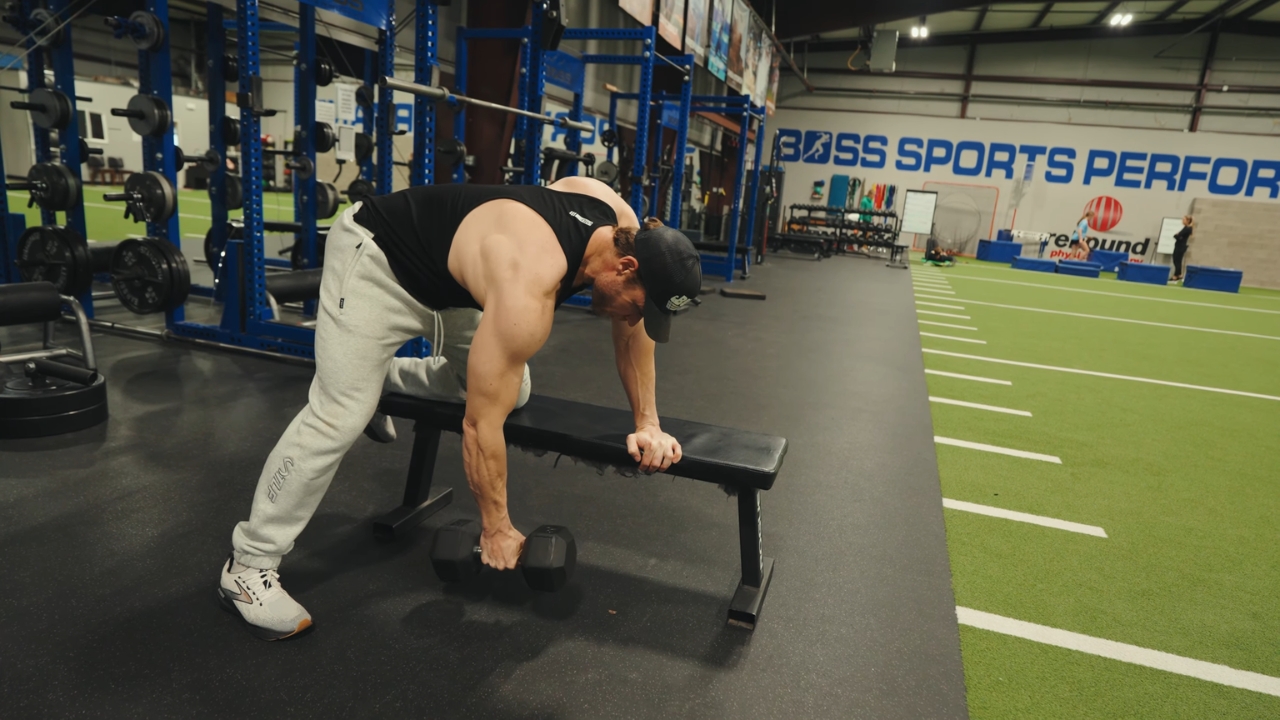
Another technique cue we’re cautious about is keeping the shoulder blade permanently pulled backward.
During a dumbbell row, the scapula should be allowed to move naturally.
As you lower the dumbbell and extend your arm, your shoulder blade can move forward around your rib cage. As you row, it moves backward again.
You don’t need to exaggerate either phase.
Your lats contribute to moving the upper arm, while several muscles around the shoulder blade help stabilize and control the movement.
Research examining scapular muscle activity during exercises including the one-arm row found substantial involvement from the middle and lower trapezius.
That’s expected. A row involves several muscle groups, even when you’re emphasizing one of them.
We prefer allowing comfortable scapular movement while keeping the torso stable.
If you deliberately squeeze your shoulder blade backward as far as possible before every repetition, you may restrict the natural reach at the bottom. If you force an exaggerated stretch by twisting your entire torso, you’ve created another unnecessary movement.
Let the shoulder blade move. Keep the rest of the setup predictable.
A Higher Row Is Useful for a Different Goal
Pulling toward the hip is our preferred approach for emphasizing the lats. However, there’s a good reason to perform higher rows as well.
Your upper back contains several muscles with different functions. A dumbbell row can be adjusted to emphasize them.
When you let your elbow travel farther outward and pull toward the lower ribs or chest, you typically increase the involvement of the rear deltoids and muscles responsible for scapular retraction.
That makes a higher row useful when upper-back development is the priority.
| Feature | Lat-Focused Row | Upper-Back Row |
|---|---|---|
| Elbow position | Closer to torso | Farther outward |
| Pull direction | Toward hip or waist | Toward ribs or lower chest |
| Main emphasis | Latissimus dorsi | Upper back and rear delts |
| Primary movement | Shoulder extension | More horizontal abduction and scapular retraction |
| Useful cue | Elbow to back pocket | Elbow outward and backward |
These are differences in emphasis. Both versions still recruit multiple back muscles.
For balanced back development, there’s room for both variations in a training program.
Our preference is to keep the variations distinct enough that you know which one you’re performing. That also makes it easier to measure progress.
Use a Weight That Lets You Keep the Row You Chose
For muscle growth, we like starting with three sets of 8 to 12 repetitions per arm.
This range provides a practical balance between meaningful resistance, controlled movement, and manageable fatigue.
It’s also straightforward to progress.
Research and practical programming both support using different repetition ranges for hypertrophy. As we’ve discussed in our article on lighter dumbbells and muscle growth, lighter loads can stimulate substantial muscle development when sets are sufficiently challenging.
There is strong evidence that similar hypertrophy can be achieved across a wide range of loading schemes (~5 to 30+ repetitions), provided sets are performed close to muscular failure. That said, some data suggest fiber type–specific differences, with heavier loads potentially favoring Type II fiber growth and lighter loads favoring Type I fibers. A recent meta-analysis offers preliminary support for this idea, although the limited number of eligible studies warrants cautious interpretation.
From a practical standpoint, those aiming to maximize hypertrophy may benefit from incorporating both heavy and light loads within a training program. For the general population, however, loading range is unlikely to have a meaningful impact on overall muscle growth—so selecting loads based on preference and adherence is a sensible approach.
https://t.co/mOKUklhniZ
— Brad Schoenfeld, PhD (@BradSchoenfeld) March 26, 2026
A 2024 meta-regression also found an association between training closer to muscular failure and greater hypertrophy, although the researchers cautioned that the precise relationship remains uncertain.
For rows, we generally suggest finishing hard sets with around one to three good repetitions left in reserve.
That means the last few repetitions should require effort while still resembling the first few.
How to Progress Your Dumbbell Rows
Suppose you begin with a dumbbell that allows three sets of eight repetitions per arm.
Keep the weight the same while gradually increasing your repetitions.
Once you can complete three sets of twelve with a consistent elbow path, stable torso, and controlled lowering, increase the resistance.
Your repetitions may initially drop back toward eight. That’s fine.
The important thing is that your technique remains recognizable as the load increases.
If you need a dramatic torso twist to finish every heavy repetition, you’ve probably progressed the weight faster than your ability to control it.
Give Heavy Rows Enough Rest
Single-arm dumbbell rows involve more than the muscles of the back. Your grip, forearms, elbow flexors, and trunk all contribute.
Fatigue in any of those areas can limit your performance.
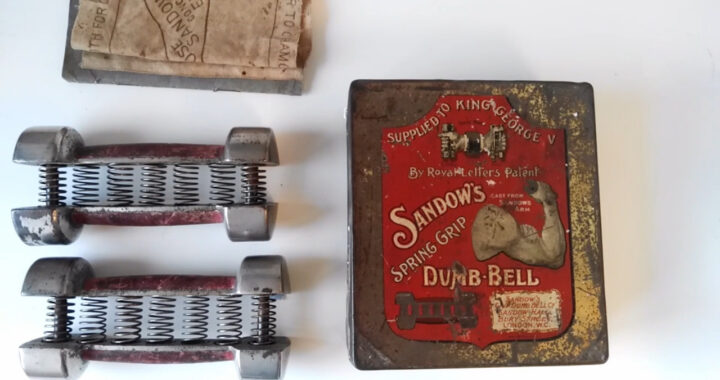
There’s an interesting historical example in Eugen Sandow’s spring-grip dumbbells, which required continuous squeezing while exercising. For a conventional dumbbell row, however, we generally want grip fatigue to stay manageable so the back muscles can receive enough training.
For challenging working sets, we recommend roughly two to three minutes of recovery.
That may seem generous for a single dumbbell exercise, but sufficient rest helps you maintain performance as the workout progresses.
We’ve covered the reasoning in more detail in our article about longer rest periods for heavy exercises.
You can adjust your rest according to the load, repetition range, and how fatigued you feel.
If you’re alternating arms, remember that your first arm receives some additional recovery while you train the second.
We still wouldn’t rush into the next set purely to keep the workout moving.
Productive repetitions matter more than finishing your back workout a few minutes earlier.
Where We Put the Single-Arm Dumbbell Row
The single-arm dumbbell row fits naturally into full-body workouts and upper-body training sessions.
We particularly like it for home training because it requires little equipment and provides substantial resistance to the back muscles.
A straightforward full-body session could include a squat or lunge, dumbbell Romanian deadlift, overhead press, flat dumbbell press, and single-arm dumbbell row.
That gives you useful lower-body, pushing, and pulling work without a complicated collection of exercises.
Beginners can also incorporate rows into our 3-day dumbbell workout and practice them consistently.
For people with less time, a simple two-session weekly routine can still be productive. Our discussion of the 2026 strength training guidelines includes an example of a two-day full-body program.
We recommend keeping the row in your routine long enough to develop technical consistency and measure progression.
Changing the exercise every couple of weeks makes it harder to tell whether you’re actually improving.
Give yourself time to add repetitions, increase resistance, and refine the movement.
Sometimes the most useful change to your back training is another month of doing the same exercise better.
Pull Toward the Hip When Lats Are the Goal
@petermiljak For Single Arm Dumbbell Rows you want to focus on your set-up and how to properly execute the movement. Give your body the best possible chance to have leverage while still allowing the target muscle to be isolated/worked. – #gymtiktok #gymtok #backworkout #dumbbellrow #gymtips #fitness ♬ original sound – Peter Miljak
The single-arm dumbbell row is one of the most useful exercises you can perform with minimal equipment. A small adjustment to your elbow path can help direct its emphasis toward different parts of your back.
When we want greater lat emphasis, our preferred technique is straightforward: support the torso, let the arm reach naturally, and drive the elbow backward toward the hip.
Keep the dumbbell under control and finish the repetition before excessive torso rotation or shoulder movement changes the exercise.
When upper-back and rear-delt development is the priority, a higher elbow path has its place.
There’s no reason to treat one variation as universally superior.
Choose the version that matches your training goal, use sufficient resistance, and progress it consistently.
And if you remember only one technical cue for your next lat-focused row, make it this: drive your elbow toward your back pocket.