For years, the fitness industry has made strength training look more complicated than it needs to be. Specialized machines, elaborate workout splits, advanced training methods, and endless exercise variations have become part of what people associate with serious results.
The American College of Sports Medicine (ACSM) has now published its first major resistance training guidelines update since 2009. And the findings make a compelling case for simple, consistent strength training.
Published in March 2026, the updated position stand draws on 137 systematic reviews involving more than 30,000 participants. Its conclusions support home-based resistance training, flexible equipment choices, and programs built around regular participation.
We think these guidelines should change how beginners approach strength training, especially those who assume they need a fully equipped gym to make meaningful progress.
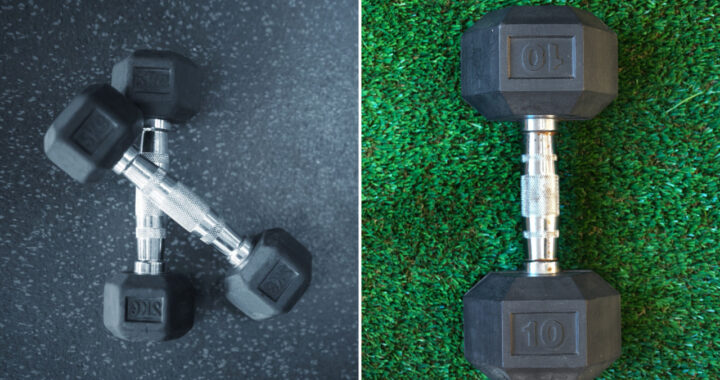
A pair of adjustable dumbbells can provide years of productive training for many people. The important questions concern how much resistance you can generate, how you organize your exercises, and whether your program continues challenging your muscles as you become stronger.
The ACSM findings also reinforce an opinion we’ve held for a long time: beginners waste far too much attention trying to optimize exercises they haven’t practiced long enough to master.
What the New 2026 Strength Guidelines Actually Say
The American College of Sports Medicine’s updated recommendations were published on March 17, 2026, following the release of the new scientific position stand earlier that month.
SPECIAL COMMUNICATIONS: American College of Sports Medicine’s 2026 Position Stand on Resistance Training Prescription for Muscle Function, Hypertrophy, and Physical Performance in Healthy Adults.
This overview of reviews determines the impact of resistance training RT prescription on muscle function and hypertrophy, utilizing evidence synthesis methods. Healthy adults should perform progressive RT, with variable prescription consistent with our findings, to improve muscle function, size, and physical performance.
Read the full overview in Medicine & Science in Sports & Exercise: https://t.co/uQpaXENld8
— Medicine & Science in Sports & Exercise (@MSSEonline) April 20, 2026
The American College of Sports Medicine’s updated recommendations were announced on March 17, 2026, following publication of the scientific position stand earlier that month.
The researchers examined findings from systematic reviews of resistance training studies involving healthy adults. They investigated how training variables influence strength, muscle hypertrophy, muscular power, and physical performance.
The major recommendations are straightforward:
- Train all major muscle groups at least twice weekly. Regular resistance training produces meaningful improvements in strength, muscle size, and physical function.
- Use heavier resistance when maximum strength is the priority. Loads around 80% of one-repetition maximum or higher are particularly effective for developing maximal strength.
- Accumulate sufficient weekly volume for muscle growth. Around 10 challenging sets per muscle group per week is a useful evidence-informed target, although beginners can make progress with fewer.
- Use the equipment you have available. Free weights, resistance bands, bodyweight exercises, and home-based training can produce worthwhile adaptations.
- Treat advanced training methods as optional tools. Training to momentary muscle failure, complex periodization, and specific equipment choices have generally shown inconsistent additional benefits across the outcomes studied.
The full findings appear in the 2026 ACSM position stand, published in Medicine & Science in Sports & Exercise. The journal also shared a public announcement of the research.
Our strongest takeaway concerns the relationship between program complexity and actual training outcomes.
People regularly spend hours researching the ideal exercise order, repetition tempo, or advanced intensity technique while struggling to complete two workouts per week.
We consider that a serious misallocation of effort.
The evidence gives us good reason to prioritize progressive resistance training, adequate weekly work, and a schedule people can maintain. Those variables deserve attention long before sophisticated programming becomes necessary.
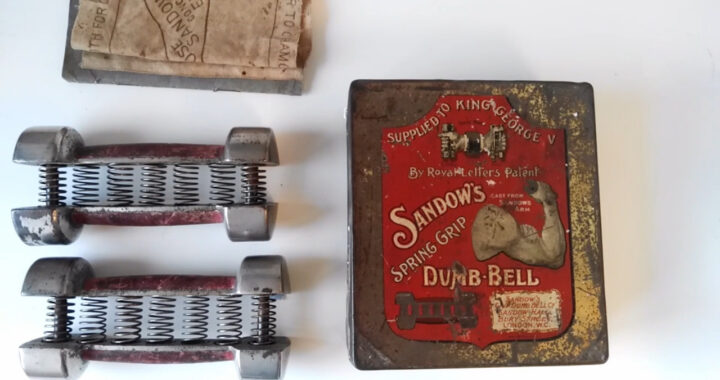
This obsession with special equipment has historical roots, too. As we explored in our article about Eugen Sandow’s spring-grip dumbbells, manufacturers were experimenting with ways to make relatively light weights feel more demanding over a century ago.
Exercise equipment has evolved enormously since then. The basic principles governing muscular adaptation remain remarkably familiar.
Why Dumbbells Are Enough for Most Home Workouts
A dumbbell’s training value comes from the resistance it provides and the demands of the exercise.
Dumbbells allow you to train nearly every major muscle group through a range of effective movement patterns.
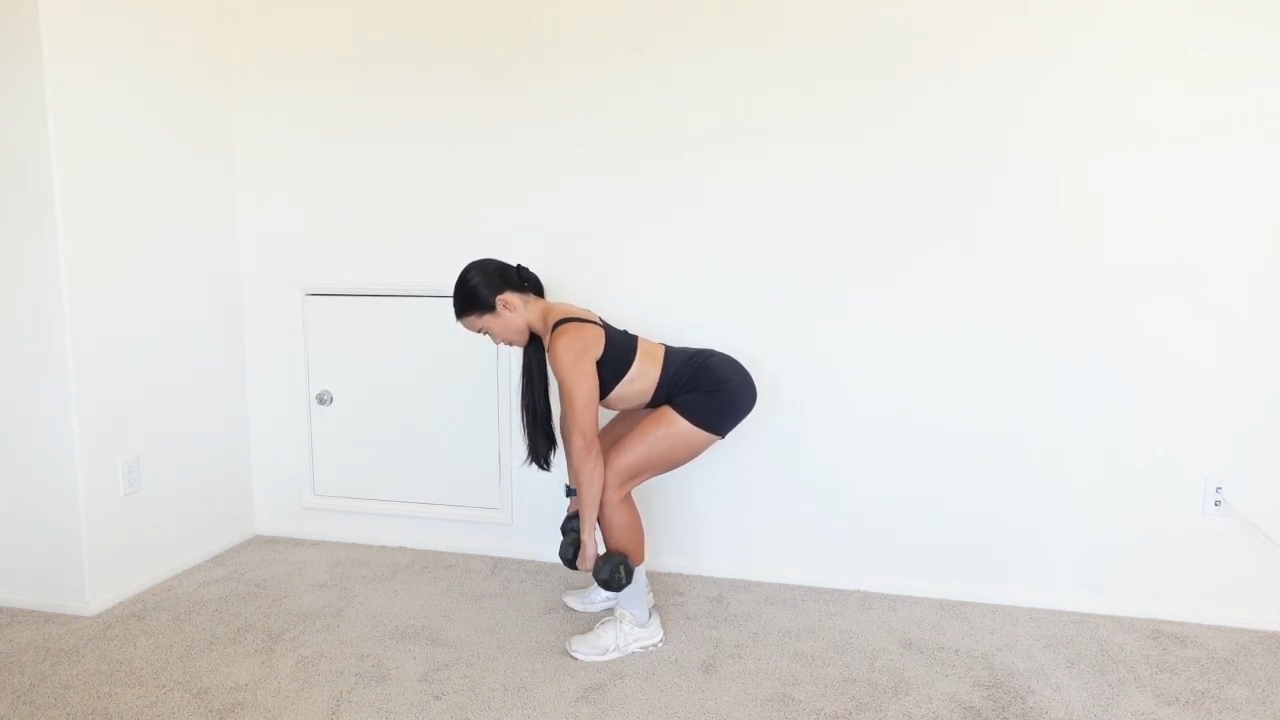
During a dumbbell floor press, your pectoral muscles, anterior deltoids, and triceps contribute to moving and stabilizing the weights. During a Romanian deadlift, your hamstrings and glutes generate force around the hip while your spinal erectors help maintain torso position.
These mechanical demands provide the foundation for adaptations in strength and muscle size.
We think dumbbells are particularly useful for home training because they support bilateral and unilateral exercises, require relatively little space, and make it easy to organize full-body sessions.
Five movements can establish a surprisingly complete strength-training foundation:
- Goblet squat: Primarily challenges the quadriceps and glutes.
- Dumbbell Romanian deadlift: Trains the hamstrings and glutes through a hip-hinge pattern.
- Dumbbell floor press: Develops the chest, triceps, and anterior shoulders.
- Single-arm dumbbell row: Trains the upper back, latissimus dorsi, and elbow flexors.
- Dumbbell overhead press: Strengthens the shoulders and triceps while requiring trunk stability.
Additional movements such as reverse lunges, lateral raises, curls, and loaded carries can address specific goals.
We particularly favor pairing a squat variation with a hip hinge. These movements distribute lower-body training across different joint actions and muscular demands.
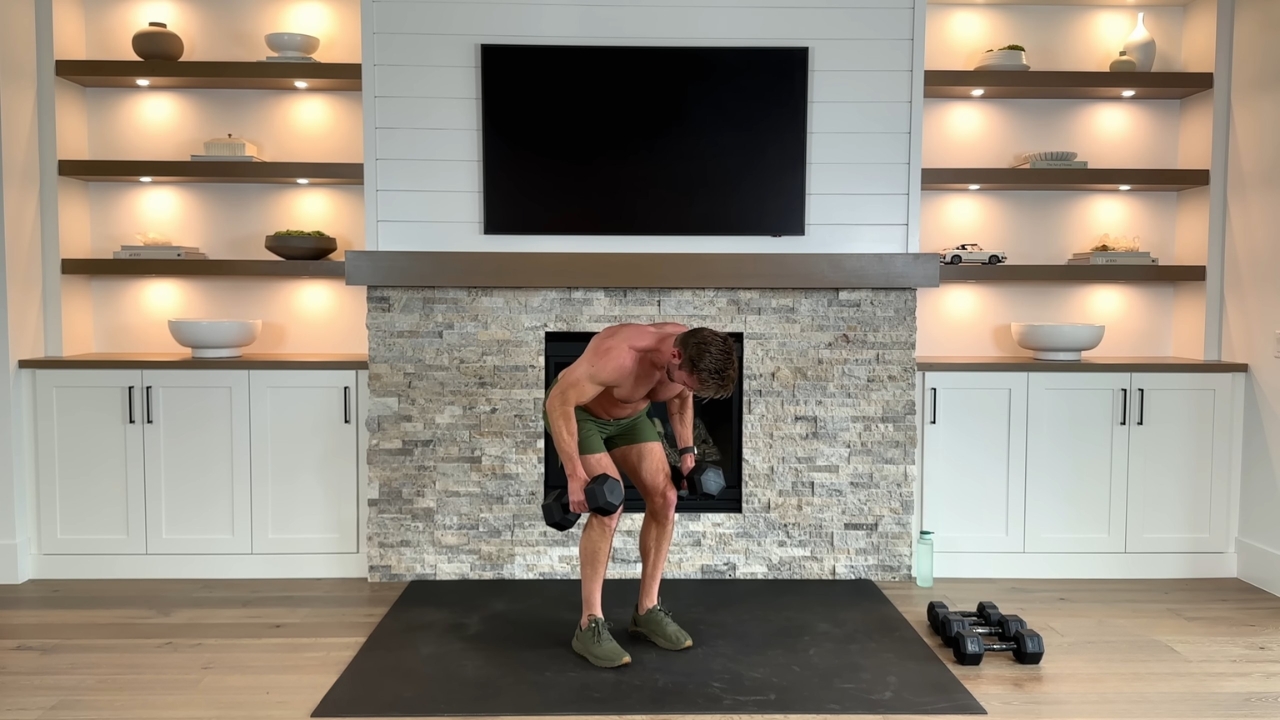
With the dumbbell Romanian deadlift, for example, we emphasize a controlled backward movement of the hips while keeping the dumbbells close to the legs. The knees remain slightly bent, and the torso inclines forward as the hips move backward.
This positioning allows the hamstrings to work under substantial tension at longer muscle lengths. As the lifter returns to standing, the hip extensors produce the force needed to complete the repetition.
We also prefer teaching a small group of exercises thoroughly before adding substantial variety.
A beginner who practices the same Romanian deadlift twice weekly develops familiarity with the movement, learns to recognize appropriate muscular tension, and can track increases in repetitions or resistance.
That familiarity is useful. Constant exercise changes make progress harder to evaluate and can introduce unnecessary learning demands.
The New Guidelines Don’t Mean Every Workout Is Equally Effective
We see one potential problem with how these recommendations are being discussed: people may interpret flexibility in training methods as evidence that programming details barely matter.
That would be a serious misreading of the research.
The ACSM position stand identifies several training variables that influence particular adaptations. Heavier loads are especially valuable for maximal strength, higher weekly volumes generally support greater hypertrophy, and explosive concentric contractions contribute to power development.
We would organize dumbbell training according to those differences.
| Training Goal | What Matters Most | Our Recommendation |
| General strength and health | Consistent resistance training | Train your whole body 2–3 times weekly |
| Maximum strength | Heavier resistance and specific practice | Prioritize challenging sets with progressively heavier weights |
| Muscle growth | Sufficient weekly sets and effort | Start with manageable volume and increase when needed |
| Muscular power | Producing force quickly | Use appropriate moderate loads with controlled, explosive lifting |
These distinctions become especially important when equipment is limited.
Someone training for general health can develop considerable strength with moderate-weight dumbbells. A competitive powerlifter needs access to loads and movement patterns that support the specific demands of their sport.
Muscle growth offers more flexibility.
Research supports hypertrophy across a wide range of loads when training effort and volume are sufficient. We explored those findings in our discussion of light dumbbells and muscle growth.
However, a dumbbell that allows 40 easy repetitions on a squat has limited usefulness for developing maximum squat strength.
We think the fitness industry frequently makes programming sound more mysterious than it is. Your chosen goal determines which training variables deserve the most attention.
The ACSM guidelines provide a scientific foundation for those decisions. They still leave room for intelligent programming and individual adjustments.
How We’d Build a Home Workout Around These Guidelines
For someone starting with adjustable dumbbells, we would begin with two full-body workouts each week.
Two weekly sessions provide regular exposure to important movements while keeping the training commitment manageable. They also allow us to observe how the person responds before increasing volume or frequency.
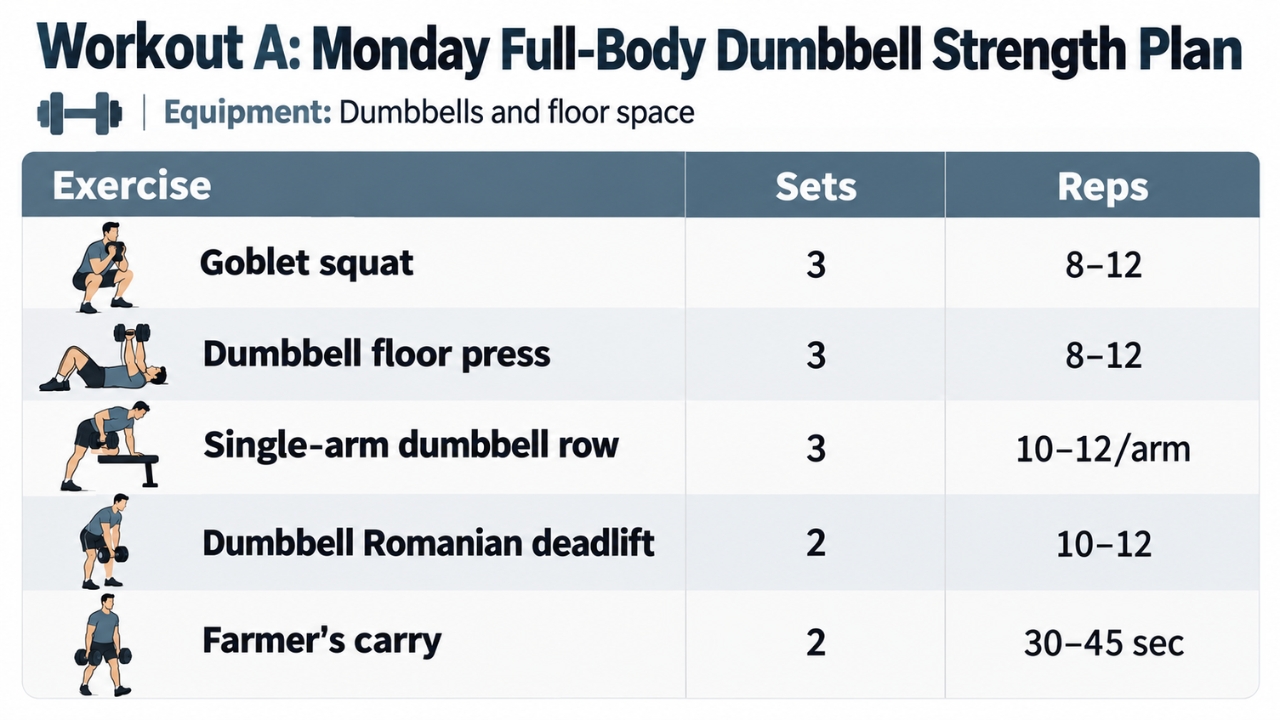
We would organize those sessions around a combination of squatting, hip hinging, horizontal pressing, overhead pressing, pulling, and loaded carries.
The following program reflects our practical application of the guidelines. It is an example of sensible programming, and its specific exercise selection and repetition ranges are our recommendations.
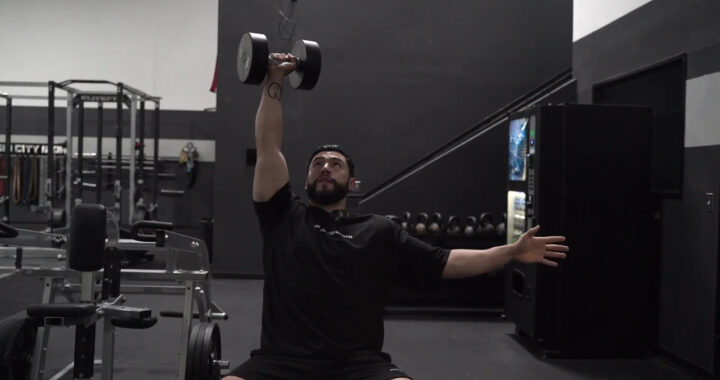
For a visual reference, this beginner full-body dumbbell workout demonstrates how several basic movements can fit into a home training session.
A Simple Two-Day Dumbbell Strength Program
Equipment: Dumbbells and floor space.
Workout A — Monday
Workout B — Thursday
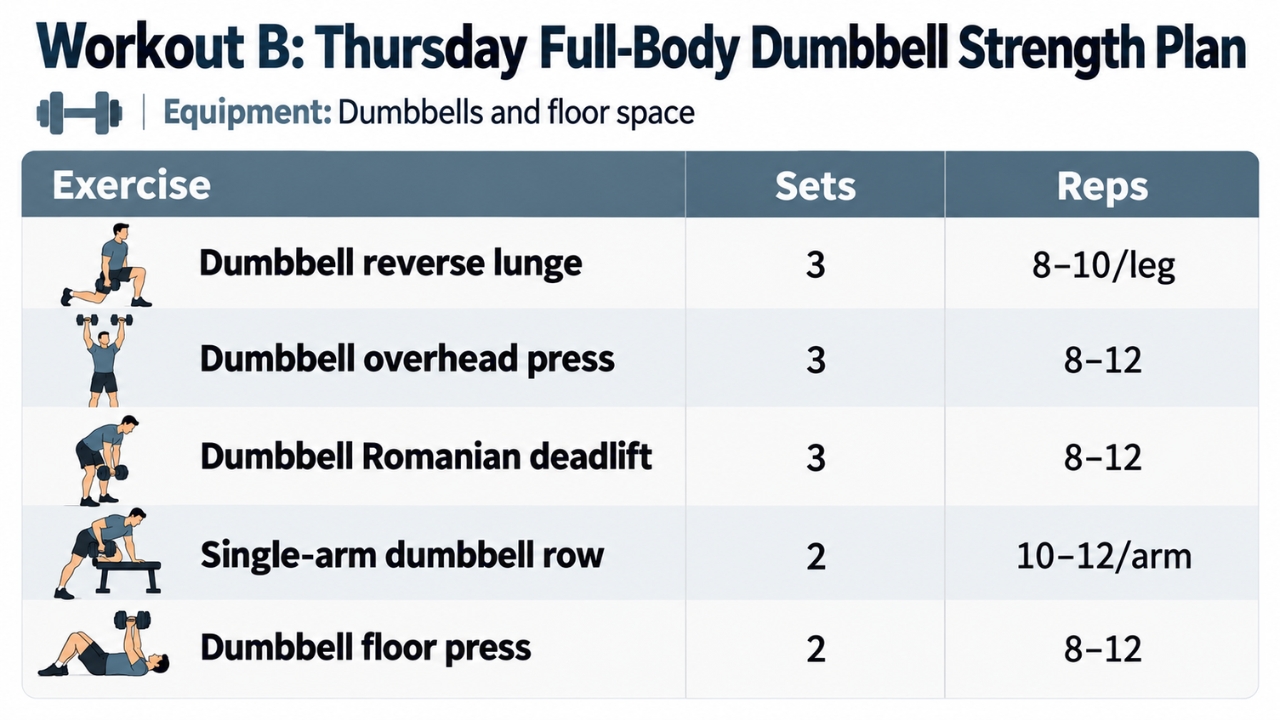
Reverse lunges introduce more unilateral lower-body work. They challenge the quadriceps and glutes while increasing demands on balance and coordination.
The overhead press provides additional shoulder training, and the Romanian deadlift, row, and floor press give several major muscle groups a second weekly stimulus.
We deliberately repeat those three exercises.
Repeating productive movements makes it easier to assess performance and develop technical consistency. We would rather see steady improvement in a few well-chosen exercises than a constantly changing collection of movements.
For the floor press, we emphasize lowering the upper arms under control until they gently contact the floor. We discuss the setup and technique in our dumbbell floor press guide.
Rest and recovery: Start with approximately 60–120 seconds between sets, and take longer after demanding exercises when performance requires it. Allow roughly 40–55 minutes for each session.
We would keep most sets challenging while leaving approximately one to three technically sound repetitions available. Beginners may need a few weeks to develop a reliable sense of how close they are to their limit.
As training experience increases, a third weekly session can become useful. Our three-day beginner dumbbell program offers another way to organize that progression.
Progression Still Matters More Than Your Equipment
One of the easiest ways to waste a perfectly good dumbbell program is to repeat the same workload for months after it has become comfortable.
Your muscles adapt to repeated training demands. Continued progress generally requires an appropriate increase in the challenge.
We strongly favor tracking performance on a small group of exercises because the numbers make progression easier to evaluate.
Consider a goblet squat performed with a 25-pound dumbbell.
During the first session, you complete three sets of eight repetitions. Over the following weeks, your performance improves:
| Session | Dumbbell Weight | Completed Sets |
|---|---|---|
| Week 1 | 25 lb | 3 × 8 |
| Week 2 | 25 lb | 3 × 9 |
| Week 3 | 25 lb | 3 × 10 |
| Week 4 | 25 lb | 3 × 12 |
Once you can complete all three sets at the top of the repetition range with consistent technique and appropriate effort, you have a reasonable opportunity to increase the weight.
With a heavier dumbbell, you may return to eight repetitions per set and begin building upward again.
This approach is commonly called double progression.
We consider it one of the most practical methods for organizing beginner dumbbell training.
There is a complication worth taking seriously: a five-pound increase can represent a substantial percentage jump when you’re using relatively light dumbbells.
Moving from 25 to 30 pounds, for example, increases the external load by 20%.
When the next available dumbbell feels too heavy, we would continue working with the current load while exploring additional repetitions, a slightly larger comfortable range of motion, or a more demanding exercise variation.
Unilateral exercises can also extend the usefulness of available weights. Split squats, for example, can provide a substantial challenge to the working leg with relatively modest external resistance.
Eventually, some exercises will require heavier equipment.
We think that limitation should be acknowledged from the beginning. It gives people a realistic understanding of how their training needs may evolve.
You Don’t Need to Train Until You Physically Can’t Lift Another Rep
View this post on Instagram
One of the more useful findings from the updated ACSM review concerns muscular failure.
Training until another repetition becomes impossible has a reputation for being necessary for serious muscle development.
The evidence is considerably more flexible. Across the studies examined, training to momentary failure did not consistently improve outcomes.
We think the obsession with failure has encouraged some genuinely poor workout habits.
People frequently judge sets by how much discomfort they produce. They chase burning muscles, extend sets until technique deteriorates, and treat the inability to complete another repetition as proof of a successful workout.
We consider that a poor standard for evaluating training quality.
A useful working set should provide enough muscular effort to stimulate adaptation while allowing appropriate recovery and repeatable performance.
For most compound dumbbell exercises, we generally favor stopping with approximately one to three good repetitions remaining.
That recommendation is a practical coaching judgment, not a universal threshold established by the ACSM guidelines.
There are situations where training closer to failure makes sense, especially when relatively light dumbbells are being used for hypertrophy. Exercise stability, experience, fatigue, and technique all influence that decision.
For example, we would be comfortable taking a controlled set of lateral raises very close to failure. We would be more conservative when someone is learning a demanding unilateral lower-body exercise.
The difficulty of judging muscular failure also deserves attention.
How many repetitions someone believes they can complete may change with their expectations, experience, and willingness to continue through discomfort. Research involving the caffeine placebo effect illustrates how expectations can influence resistance exercise performance.
Discussions around training effort, including those raised in EVLO FITNESS’s Instagram post, are useful reminders that muscular fatigue deserves more careful consideration than simply pushing every set to its limit.
Rest periods matter as well.
We strongly dislike shortening rest intervals simply to make strength workouts feel harder. Research and practical experience support taking longer rests between heavy dumbbell sets when needed to maintain performance.
If someone completes twelve controlled floor presses in the first set and manages only six in the second because they are still breathing heavily, we would increase the rest period before assuming the muscles have reached their useful training limit.
Our priority is the quality and progression of the work performed.
Where Dumbbells Have Real Limitations
We believe dumbbell training is one of the most accessible approaches to strength development. Its limitations also deserve careful consideration.
The most obvious problem is available resistance.
A pair of 40-pound dumbbells could remain challenging for overhead presses, rows, and many isolation exercises while becoming insufficient for a stronger lifter’s lower-body training.
The quadriceps and glutes are capable of producing substantial force. As their strength increases, exercises that distribute resistance across both legs may eventually require more loading than a typical home dumbbell setup provides.
We usually address this by exploring unilateral variations first.
Bulgarian split squats, reverse lunges, and single-leg Romanian deadlifts can increase the relative demands on each working leg.
They also introduce additional balance and stability requirements. We choose variations according to the person’s ability to perform them consistently and load the target muscles effectively.
Grip fatigue presents another limitation.
During heavy Romanian deadlifts or farmer’s carries, the hands may become exhausted before the hip extensors or other intended muscles have received enough work.
A stronger grip can develop through regular training, although it can still interfere with exercises where another muscle group is the priority.
At some point, heavier dumbbells, lifting straps where appropriate, or additional equipment may become worthwhile.
Our position is straightforward: the best home training equipment is equipment that allows you to challenge the muscles you intend to train.
For many beginners, a modest adjustable dumbbell setup can satisfy that requirement for a considerable period.
More experienced lifters will need to evaluate their equipment according to their current strength and specific goals.
The updated ACSM guidelines support using a variety of resistance training methods. That flexibility gives people more ways to organize effective workouts.
The Biggest Lesson Is About Consistency, Not Dumbbells
The most consequential part of the 2026 ACSM position stand, in our view, concerns what it means to have a sustainable strength-training program.
The recommendations place considerable emphasis on regular participation and individualizing exercise prescriptions.
We think this deserves more attention than it typically receives.
Many workout programs are designed around an idealized person with plenty of free time, excellent recovery, and unlimited enthusiasm for training.
Actual training schedules have to coexist with work, family responsibilities, sleep, other physical activities, and ordinary fluctuations in motivation.
We consider a two-day full-body program an excellent starting point precisely because it is manageable.
A person completing two productive workouts every week for a year accumulates more than 100 strength-training sessions.
That is a substantial amount of practice, muscular effort, and opportunity for progressive overload.
Consistency also creates a foundation that can survive interruptions.
As we discussed in our analysis of a 10-week break from strength training, previously untrained participants were able to regain lost muscle size and strength relatively quickly after returning to exercise.
We find that encouraging because sustainable training involves returning to the routine after normal disruptions.
There is another important consideration: exercise variety has become almost a selling point in itself.
We think many beginners would progress faster by deliberately reducing the number of exercises in their programs.
Choose a handful of effective movements. Practice them frequently enough to develop competence. Record the weights and repetitions. Improve those numbers over time while maintaining sound technique.
That process gives you meaningful information about whether your training is working.
The new ACSM guidelines provide strong scientific support for a flexible approach to resistance training. They also confirm that heavier loading, training volume, and other programming variables can be adjusted to pursue particular outcomes.
For people training at home, the implications are substantial.
A pair of dumbbells can provide the resistance necessary to develop strength, increase muscle size, and improve physical function. The program should evolve as the person becomes stronger, and equipment should be reassessed when it no longer supports useful progression.
We would encourage anyone beginning home strength training to start with two full-body sessions each week, focus on a manageable selection of exercises, and make progress measurable.
Our strongest recommendation is to earn the need for a more complicated program.
Build consistency, develop your technique, and demonstrate meaningful progress with the equipment you already have.
Additional training days, specialized equipment, and more advanced programming can be introduced when your results and goals justify them.