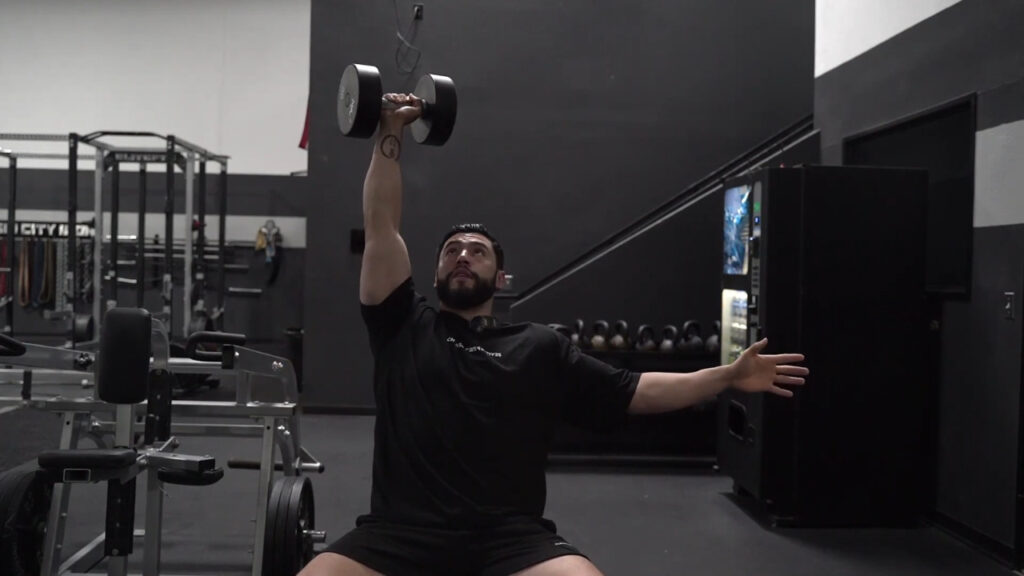
Training your right arm can make your left arm stronger, even when the left arm never touches a dumbbell.
Researchers call this cross-education, a phenomenon in which resistance training produces strength improvements in the opposite, untrained limb.
The effect has been documented across numerous controlled studies. It also reveals something important about strength development: muscular performance depends heavily on how the nervous system coordinates force production.
We think cross-education deserves particular attention in rehabilitation. For healthy lifters, its practical value lies in understanding unilateral training and the adaptations occurring beyond the working muscles.
Researchers Found Strength Gains in Arms That Never Trained
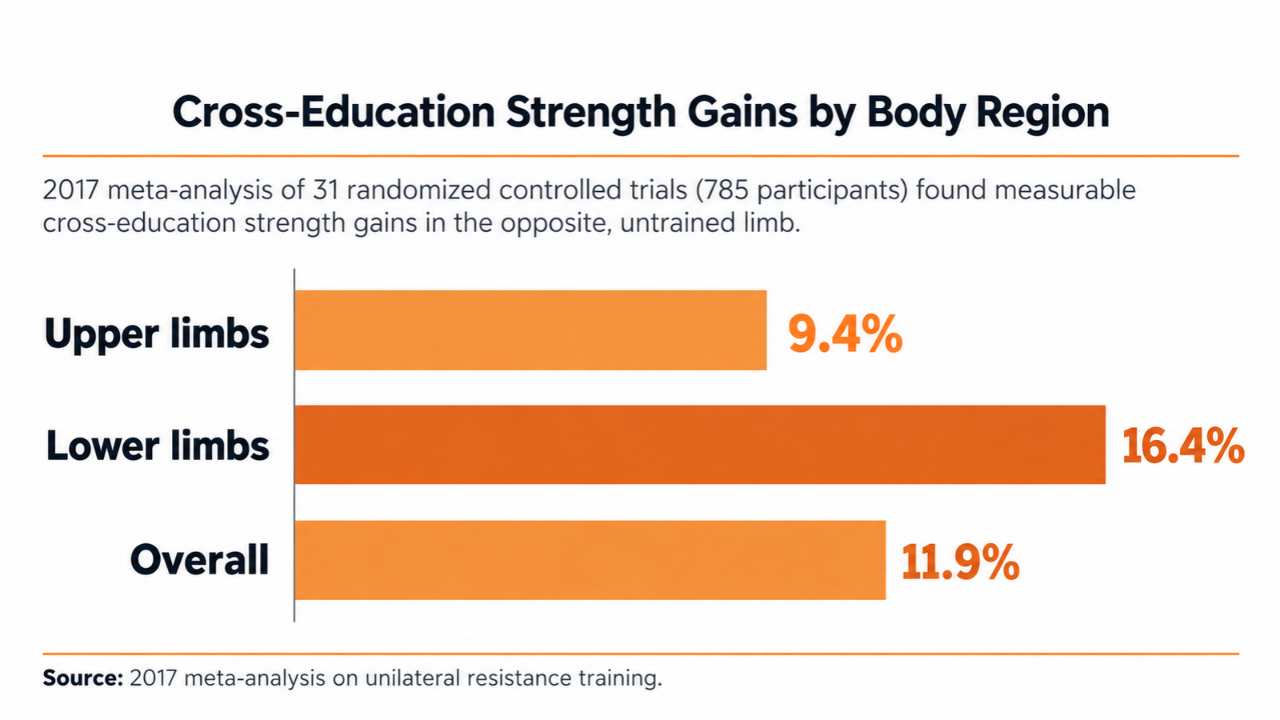
A 2017 meta-analysis examined 31 randomized controlled trials involving 785 participants. The researchers investigated how resistance training one limb affected strength in the opposite, untrained limb.
The pooled results showed an average strength improvement of 11.9% in the untrained limb.
Results differed by body region:
Eccentric training, which emphasizes muscle lengthening under resistance, produced an average contralateral strength improvement of 17.7%.
That’s a substantial finding. Imagine completing several weeks of single-arm curls and discovering that your untrained arm has also improved its strength.
However, these percentages represent pooled averages from different training protocols. The researchers identified methodological limitations and a high risk of bias. Individual results can differ considerably.
We also wouldn’t interpret the eccentric-training result as a reason to abandon conventional repetitions. The evidence is too heterogeneous to establish one contraction method as universally superior.
Our interpretation: Cross-education is a genuine training adaptation with meaningful implications for strength development. The research supports its existence much more confidently than it supports any single optimal training method.
Your Nervous System Is Doing More Than You Think
Every dumbbell repetition requires coordinated activity between the nervous system and skeletal muscles.
During a curl, the biceps brachii and other elbow flexors generate force. Meanwhile, the central nervous system organizes muscle activation, movement timing, and the level of effort required.
Repeated training influences these processes.
A 2018 systematic review examined neurophysiological adaptations associated with cross-education. The findings suggested that changes in cortical inhibitory mechanisms may contribute to strength improvements in the untrained limb.
In practical terms, repeated unilateral contractions can influence neural pathways involved in controlling the opposite side.
The precise mechanisms remain unresolved. Researchers have examined changes in motor-cortex excitability, intracortical inhibition, and other aspects of neural regulation.
We find the distinction between muscle development and motor performance particularly useful here.
Someone can improve their ability to activate muscles and produce force without experiencing proportional increases in muscle size. This helps explain why beginners frequently gain strength during the early stages of resistance training.
Cross-education provides an especially clear example of that relationship.
The Other Arm Gets Stronger, but Does It Grow?
Strength improvement in an untrained arm raises an obvious question: Does the arm also gain muscle?
A 2026 systematic review and meta-analysis examined 31 studies involving 1,214 participants.
Researchers identified small but statistically significant improvements in strength in the opposite, untrained upper limb. They found no statistically significant improvement in muscle thickness.
The certainty of evidence ranged from low to very low.
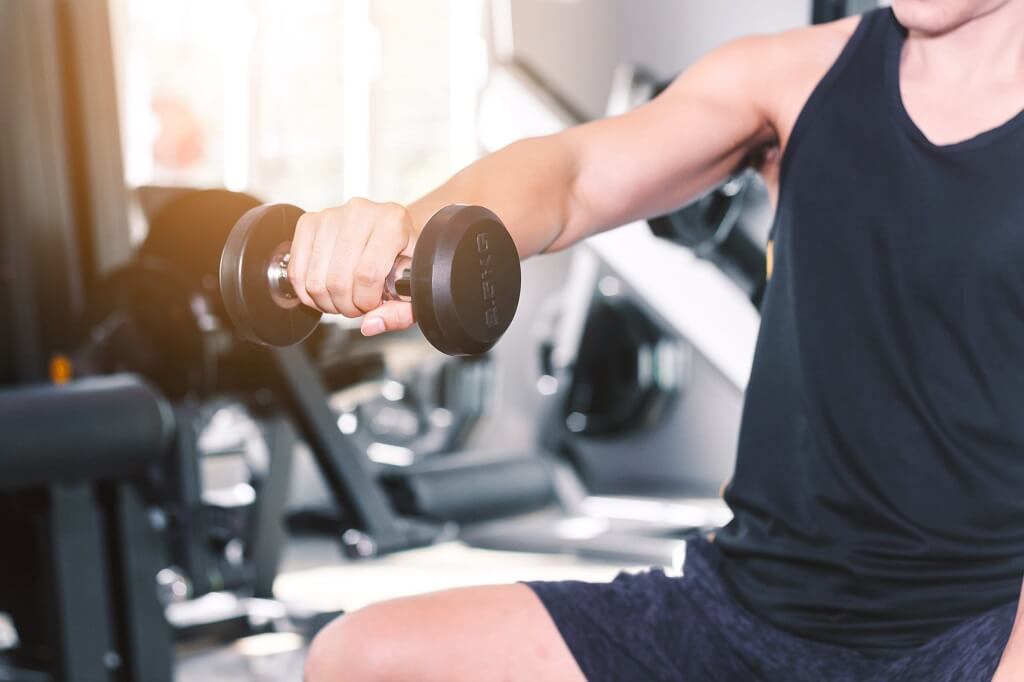
Our position is that anyone whose primary goal is muscle hypertrophy should train the muscles they want to develop directly.
Cross-education offers an interesting neurological advantage. The evidence provides little support for deliberately leaving an arm untrained as a muscle-building strategy.
Direct resistance exercise exposes the working muscles to mechanical loading that contributes to hypertrophy.
As we explain in our article on light dumbbells and muscle growth, sufficiently challenging sets can stimulate muscle development across a broad range of resistance loads.
For bigger biceps, keep curling with both arms. The strength transferred through cross-education is a welcome additional adaptation.
This Could Be Particularly Useful During Injury Recovery
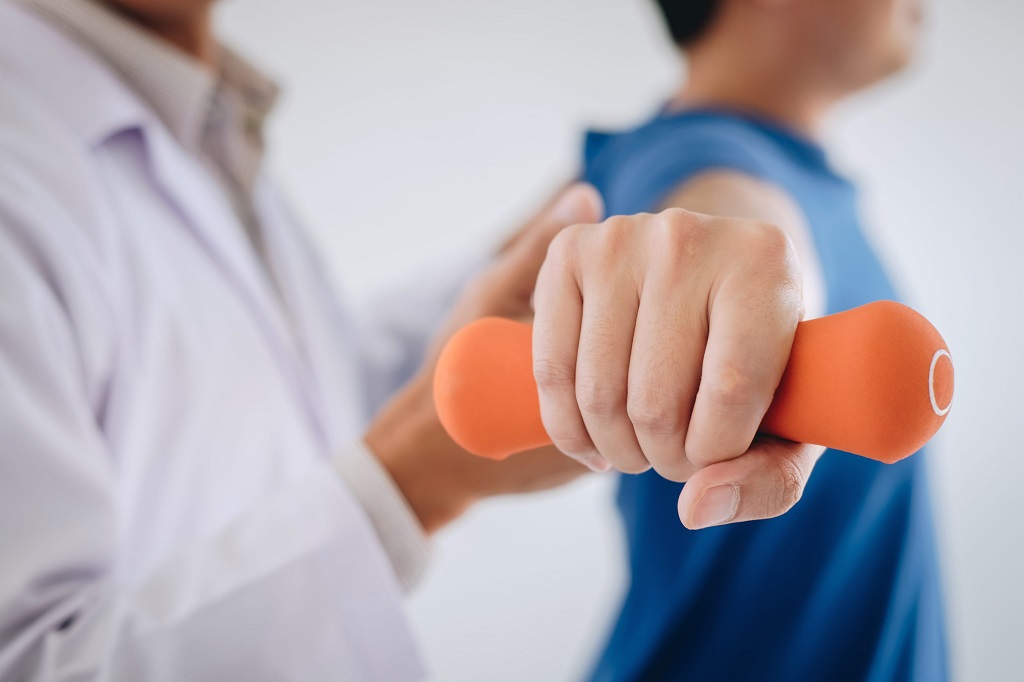
Rehabilitation is where we believe cross-education has its strongest practical justification.
Consider someone whose left arm must remain immobilized for several weeks. Their right arm can still perform resistance exercises, provided those movements are medically appropriate.
Training the healthy arm may help reduce strength losses in the immobilized limb.
A 2026 meta-analysis on limb immobilization examined eight studies involving 189 participants.
The researchers found that exercising the nonimmobilized arm reduced strength losses in the immobilized arm compared with immobilization alone. They also observed a smaller protective effect on muscle size.
Those results make cross-education a promising rehabilitation strategy.
There are important limitations. The included experiments involved healthy participants undergoing immobilization. Their findings cannot automatically be generalized to people recovering from fractures, surgical procedures, or complex injuries.
We would also pay close attention to exercise selection. A standing single-arm overhead press can demand considerable trunk stabilization. That may create unwanted stress during certain recovery periods.
Our recommendation is to treat opposite-side training as a clinician-supervised rehabilitation option. The treating physical therapist should determine appropriate movements, loads, and training frequency.
Preserving strength during immobilization could make a meaningful difference when normal training eventually resumes.
How We Use Single-Arm Dumbbell Exercises
We regularly recommend unilateral exercises for healthy lifters because they make individual limb performance easier to evaluate.
When both arms move simultaneously, the stronger side can sometimes compensate through differences in movement mechanics or effort.
Training one arm at a time makes these differences easier to identify.
We particularly favor three exercises:
- Single-arm dumbbell rows: Support the free hand on a stable surface, maintain a controlled torso position, and pull the working elbow toward the hip. Our single-arm row technique guide explains how elbow positioning influences the movement.
- Single-arm overhead presses: Brace the abdominal muscles and glutes before pressing. Maintain a stable torso and avoid excessive sideways leaning. We prefer reducing the load whenever trunk compensation becomes noticeable.
- Alternating dumbbell curls: Keep the upper arm relatively stationary and control the lowering phase. Each arm should complete its repetitions through a consistent range of motion.
For a visual reference, this single-arm dumbbell row tutorial demonstrates the movement.
We strongly favor keeping unilateral exercises in a regular training program, particularly for people who have noticeable strength differences between sides.
These exercises also give us useful information about coordination and movement consistency.
One important consideration is that unilateral training with both limbs doesn’t isolate cross-education. Each side receives direct resistance training, so both can develop independently.
That’s exactly what we want during ordinary strength workouts.
A Simple Way to Include Unilateral Training
For someone looking to add unilateral work to an upper-body routine, we’d start with the following exercises:
| Exercise | Sets | Reps |
|---|---|---|
| Single-arm dumbbell row | 3 | 8–12 per arm |
| Single-arm shoulder press | 3 | 6–10 per arm |
| Alternating dumbbell curl | 2 | 10–12 per arm |
This is a short upper-body session that can be performed twice weekly alongside appropriate chest and lower-body training.
For another example of unilateral exercise programming, see this 35-minute unilateral arm workout.
We’d follow three programming principles:
1. Start With the Weaker Arm
Choose a weight that allows controlled repetitions on that side. When matching the work between arms, let the weaker side determine the repetitions.
2. Give Demanding Sets Enough Recovery
Fatigue can quickly compromise performance during rows and presses. Our article on rest times between heavy sets explains why adequate recovery improves training quality.
3. Track Each Arm Separately
Record the load, repetitions, and exercise technique. Persistent differences can help identify where additional attention may be useful.
Beginners can incorporate these movements into our 3-day dumbbell workout, which provides a broader full-body training structure.
We would also avoid adding unnecessary unilateral exercises simply to create a more complicated workout. Two or three carefully selected movements can provide plenty of useful information about individual limb performance.
Cross-Education Doesn’t Mean You Should Train Only One Side
View this post on Instagram
The evidence for cross-education is convincing enough to influence how we think about strength development. It also presents an opportunity for poor programming advice.
We strongly disagree with the idea of deliberately neglecting a healthy arm because the opposite arm can gain some indirect strength.
The untrained limb generally experiences smaller strength improvements. Muscle growth remains uncertain, and there is no guarantee that unilateral training will eliminate existing strength imbalances.
For healthy adults, we recommend training both sides consistently, progressing resistance when appropriate, and monitoring differences in movement quality.
You can also explore this additional unilateral training post from the original exercise references.
Cross-education has its clearest practical value when direct training is temporarily restricted. During ordinary workouts, we consider it a secondary benefit of unilateral resistance exercise.
The larger lesson is that strength development involves substantial nervous-system adaptation. Training one arm can influence how the opposite arm produces force, even without direct muscular loading.
That’s a valuable finding, especially when keeping someone strong during a training interruption matters.